The Sun
The Sun is a yellow dwarf star (G2V), about 4.6 billion years old, and the dominant gravitational force in the Solar System. It has a diameter of roughly 1.4 million kilometers and contains around 99.8% of the Solar System’s mass. Nuclear fusion in its core converts hydrogen into helium, producing energy that warms the planets. Above the core lie the radiative and convective zones, followed by the visible photosphere (~5,500 °C), the chromosphere, and the much hotter corona (~2 million °C).
Source: science.nasa.gov
APODs including "The Sun"
Moon AND Sun
07/09/2001
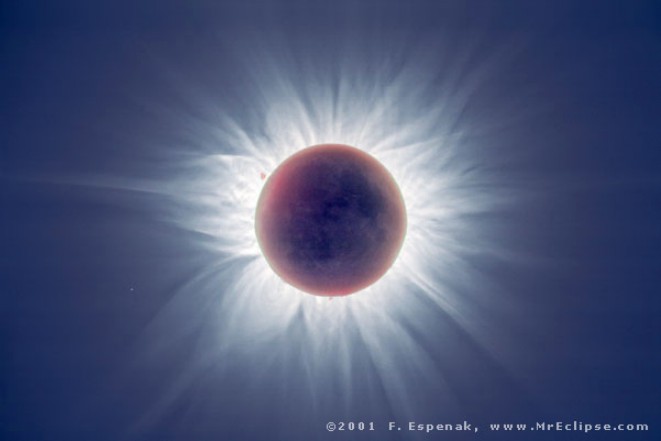
Today's composite image was made from 22 separate pictures of the Moon and Sun all taken from Chisamba, Zambia during the total phase of the 2001 June 21 solar eclipse. The multiple exposures were digitally processed and combined to simultaneously show a wealth of detail which no single camera exposure or naked-eye observation could easily reveal. Most striking are the incredible flowing streamers of the Sun's outer atmosphere or solar corona, notoriously difficult to see except when the new Moon blocks the bright solar disk. Features on the darkened near side of the Moon can also be made out, illuminated by sunlight reflected from a full Earth. A giant solar prominence seems to hang just beyond the Moon's eastern (left) edge while about one diameter farther east of the eclipsed Sun is the relatively faint (4th magnitude) star 1 Geminorum.