The Sun
The Sun is a yellow dwarf star (G2V), about 4.6 billion years old, and the dominant gravitational force in the Solar System. It has a diameter of roughly 1.4 million kilometers and contains around 99.8% of the Solar System’s mass. Nuclear fusion in its core converts hydrogen into helium, producing energy that warms the planets. Above the core lie the radiative and convective zones, followed by the visible photosphere (~5,500 °C), the chromosphere, and the much hotter corona (~2 million °C).
Source: science.nasa.gov
APODs including "The Sun"
Zodiacal Light and the False Dawn
12/09/2001
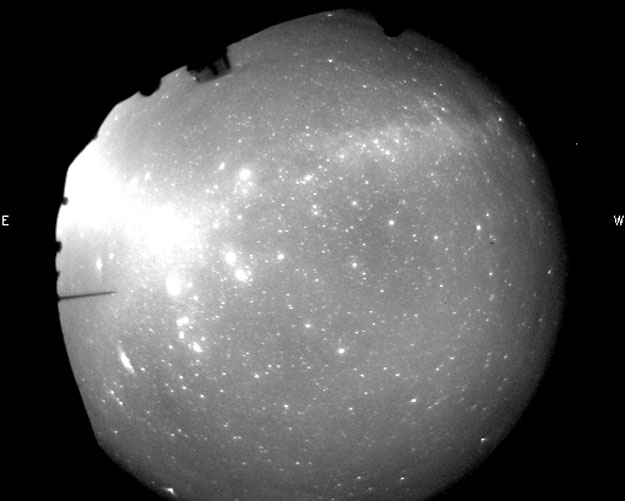
An unusual triangle of light will be particularly bright near the eastern horizon before sunrise during the next two months for observers in Earth's northern hemisphere. Once considered a false dawn, this triangle of light is actually Zodiacal Light, light reflected from interplanetary dust particles. The triangle is clearly visible on the left of the above frame taken from Mauna Kea in Hawaii on August 30 by one of the developing global network of fisheye nighttime web cameras called CONCAMs. Zodiacal dust orbits the Sun predominantly in the same plane as the planets: the ecliptic. Indeed, the triangle points to bright spots Jupiter and Saturn, with Saturn nearer the center. Zodiacal light is so bright this time of year because the dust band is oriented nearly vertical at sunrise, so that the thick air near the horizon does not block out relatively bright reflecting dust. Zodiacal light is also bright for people in Earth's northern hemisphere in March and April just after sunset.