The Sun
The Sun is a yellow dwarf star (G2V), about 4.6 billion years old, and the dominant gravitational force in the Solar System. It has a diameter of roughly 1.4 million kilometers and contains around 99.8% of the Solar System’s mass. Nuclear fusion in its core converts hydrogen into helium, producing energy that warms the planets. Above the core lie the radiative and convective zones, followed by the visible photosphere (~5,500 °C), the chromosphere, and the much hotter corona (~2 million °C).
Source: science.nasa.gov
APODs including "The Sun"
A Solar Prominence Erupts
24/09/2001
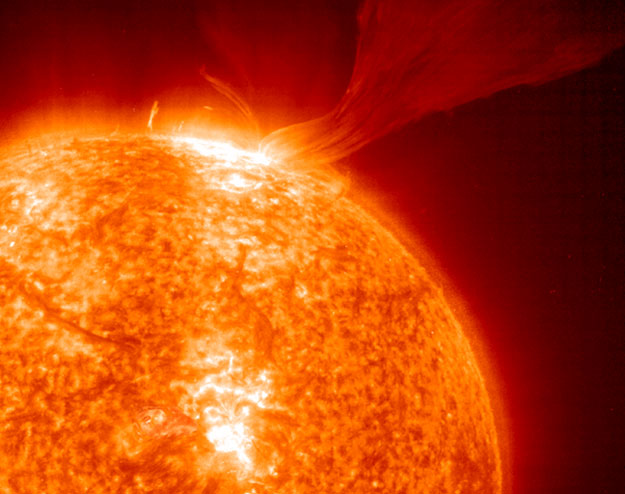
Our Sun is still very active. Last year, our Sun went though Solar Maximum, the time in its 11-year cycle where the most sunspots and explosive activities occur. Sunspots, the Solar Cycle, and solar prominences are all caused by the Sun's changing magnetic field. Pictured above is a solar prominence that erupted on May 15, throwing electrons and ions out into the Solar System. The image was taken in the ultraviolet light emitted by a specific type of ionized helium, a common element on the Sun. Particularly hot areas appear in white, while relatively cool areas appear in red. Our Sun should gradually quiet down until Solar Minimum occurs in 2007.