The Sun
The Sun is a yellow dwarf star (G2V), about 4.6 billion years old, and the dominant gravitational force in the Solar System. It has a diameter of roughly 1.4 million kilometers and contains around 99.8% of the Solar System’s mass. Nuclear fusion in its core converts hydrogen into helium, producing energy that warms the planets. Above the core lie the radiative and convective zones, followed by the visible photosphere (~5,500 °C), the chromosphere, and the much hotter corona (~2 million °C).
Source: science.nasa.gov
APODs including "The Sun"
Coronal Inflow
29/11/2001
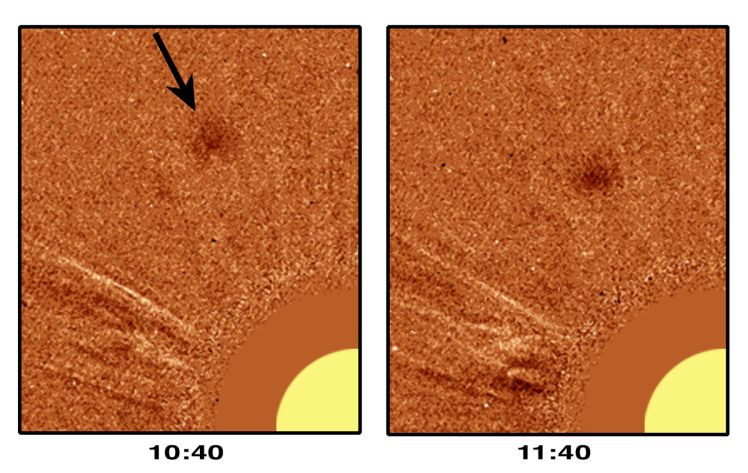
The active Sun has thrown a lot our way lately, including storms of particles streaming outward in the solar wind and clouds of plasma which triggered awesome auroral displays. Still, a growing body of intriguing observations from the LASCO instrument on board the space-based SOlar and Heliospheric Observatory (SOHO) indicates material also flows back toward the Sun, starting from over 2 million kilometers above its visible surface. Relatively hard to detect against the outflowing solar corona, a dark inflowing cloud's relative motion is tracked above in two highly processed images recorded an hour apart. The solar surface, graphically shown by the yellow quarter circle at the lower right, is blocked from view by a smooth occulting disk. Fighting against a solar wind outflow of about 120 kilometers per second the cloud seems to be moving inward at 50-100 kilometers per second. Occasionally appearing as often as once per hour, the clouds, seem to be dragged in by collapsing magnetic field loops rather than gravity alone. Researchers are now working to relate this surprising inflow to the solar wind and magnetic environment of the Sun.