The Sun
The Sun is a yellow dwarf star (G2V), about 4.6 billion years old, and the dominant gravitational force in the Solar System. It has a diameter of roughly 1.4 million kilometers and contains around 99.8% of the Solar System’s mass. Nuclear fusion in its core converts hydrogen into helium, producing energy that warms the planets. Above the core lie the radiative and convective zones, followed by the visible photosphere (~5,500 °C), the chromosphere, and the much hotter corona (~2 million °C).
Source: science.nasa.gov
APODs including "The Sun"
A Sky Filled with Leonids
05/12/2001
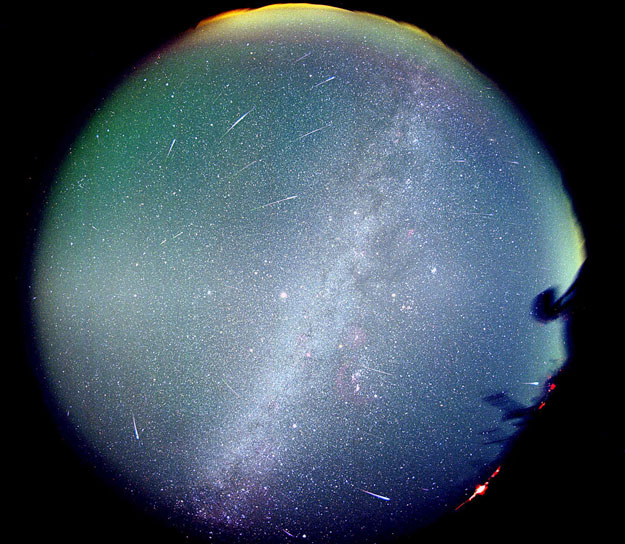
In the early morning hours of November 19, amateur Chen Huang-Ming caught a sky filled with astronomical wonders. With his fisheye camera set up on Ho-Huan Mountain in Taiwan for a half-hour exposure, he started the above image a local time of 2:33 am. First, the many famous stars and nebulas captured are too numerous to count. Planets Jupiter and Saturn are visible, while the plane of our Milky Way Galaxy sweeps diagonally across the image. What makes this image most spectacular, however, are the over 100 bright meteors visible from the 2001 Leonids Meteor Shower. The meteor shower is caused by the Earth plowing through a stream of sand-sized ice particles shed years ago by Comet Tempel-Tuttle. Note that the meteors can all be tracked back to a radiant in the constellation Leo, the direction from which the particles orbit the Sun.