The Sun
The Sun is a yellow dwarf star (G2V), about 4.6 billion years old, and the dominant gravitational force in the Solar System. It has a diameter of roughly 1.4 million kilometers and contains around 99.8% of the Solar System’s mass. Nuclear fusion in its core converts hydrogen into helium, producing energy that warms the planets. Above the core lie the radiative and convective zones, followed by the visible photosphere (~5,500 °C), the chromosphere, and the much hotter corona (~2 million °C).
Source: science.nasa.gov
APODs including "The Sun"
Red Auroral Corona
15/01/2002
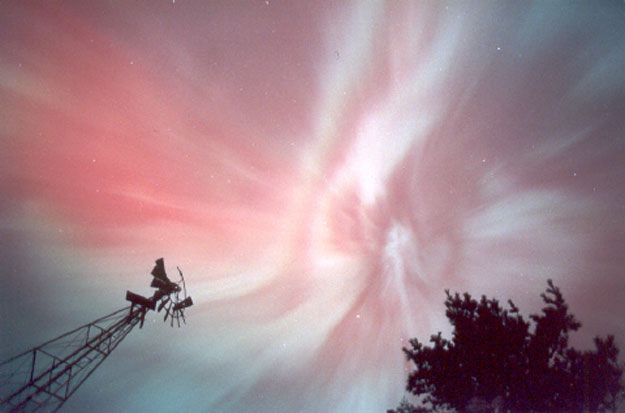
Few auroras show this level of detail. This unusual display of an auroral corona occurred on Earth three days after an unusual solar event -- the fifth most powerful explosion yet recorded on the Sun. An X14-class solar flare on April 15 sent a tremendous Coronal Mass Ejection (CME) into the Solar System. This CME did not directly impact the Earth. The Solar-System wide shock wave it created probably did, however, causing a G3-class geomagnetic storm and a night filled with colorful auroras across much of northern North America. The unusual red color of this Michigan aurora is caused by solar ions striking oxygen molecules 300 kilometers high in Earth's atmosphere. More typical green auroras are caused by oxygen recombining only 100 kilometers high.