The Sun
The Sun is a yellow dwarf star (G2V), about 4.6 billion years old, and the dominant gravitational force in the Solar System. It has a diameter of roughly 1.4 million kilometers and contains around 99.8% of the Solar System’s mass. Nuclear fusion in its core converts hydrogen into helium, producing energy that warms the planets. Above the core lie the radiative and convective zones, followed by the visible photosphere (~5,500 °C), the chromosphere, and the much hotter corona (~2 million °C).
Source: science.nasa.gov
APODs including "The Sun"
Saturn and Vesta in Taurus
18/01/2002
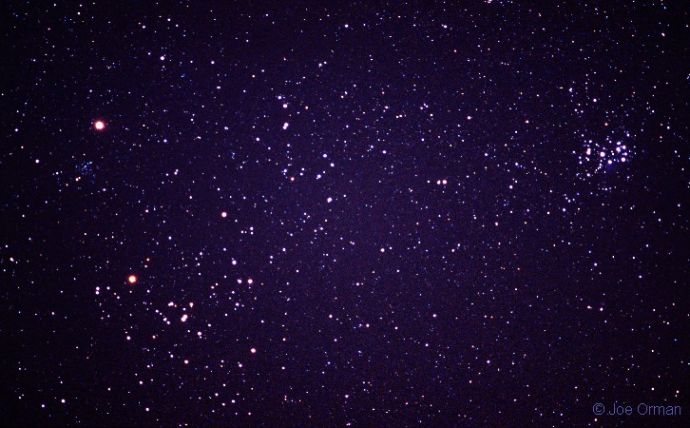
Last November, while skygazing toward the constellation Taurus, astrophotographer Joe Orman arranged this time exposure to include the lovely Hyades and Pleiades star clusters in the field of his telephoto lens. A distance of 400 light-years for the close-knit Pleiades and 150 light-years for the V-shaped Hyades puts these clusters in the general galactic neighborhood of the Sun. Punctuating the Hyades' appearance, bright yellow Aldebaran, 60 light-years away, is not actually a member of the cluster, but it is Taurus' brightest star. Above Aldebaran a yellower, even brighter Saturn is is seen about 1.2 light-hours from our fair planet. Last and least massive, one of the faint specks below Aldebaran is main-belt asteroid Vesta, a mere 13 light-minutes away. Still cruising through Taurus, Vesta is steadily approaching a close alignment or conjunction with Saturn on March 19. Need a program to follow the players? Click on the image for a labeled version.