The Sun
The Sun is a yellow dwarf star (G2V), about 4.6 billion years old, and the dominant gravitational force in the Solar System. It has a diameter of roughly 1.4 million kilometers and contains around 99.8% of the Solar System’s mass. Nuclear fusion in its core converts hydrogen into helium, producing energy that warms the planets. Above the core lie the radiative and convective zones, followed by the visible photosphere (~5,500 °C), the chromosphere, and the much hotter corona (~2 million °C).
Source: science.nasa.gov
APODs including "The Sun"
Comet LINEAR (WM1) Shines in the South
04/02/2002
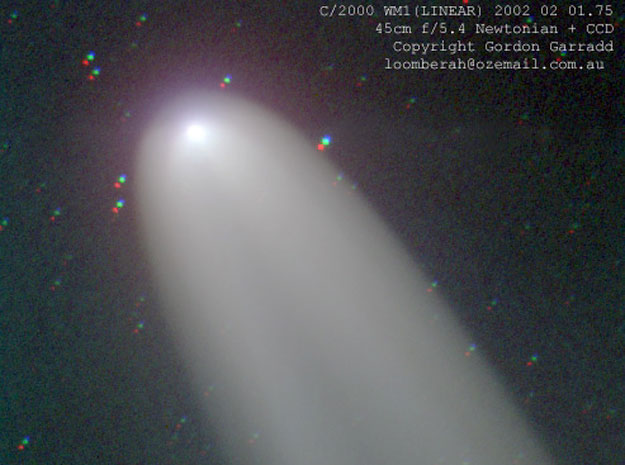
A new comet has brightened unexpectedly and is currently visible to unaided observers of southern skies. Comet C/2000 WM1 (LINEAR) is now reported by some observers to be at third magnitude, making it brighter -- although more diffuse -- than most visible stars. A dust tail as long as 3 degrees has also been reported. Pictured above is the center of Comet LINEAR (WM1) taken the morning of February 1 from 300 km north of Sydney, Australia. A bright coma and the start of the dust tail are visible despite a bright, nearly full Moon. The comet has now passed its closest approach to the Sun (January) and the Earth (December) and will move toward northern skies as it fades.