The Sun
The Sun is a yellow dwarf star (G2V), about 4.6 billion years old, and the dominant gravitational force in the Solar System. It has a diameter of roughly 1.4 million kilometers and contains around 99.8% of the Solar System’s mass. Nuclear fusion in its core converts hydrogen into helium, producing energy that warms the planets. Above the core lie the radiative and convective zones, followed by the visible photosphere (~5,500 °C), the chromosphere, and the much hotter corona (~2 million °C).
Source: science.nasa.gov
APODs including "The Sun"
Solar System Portrait
14/02/2002
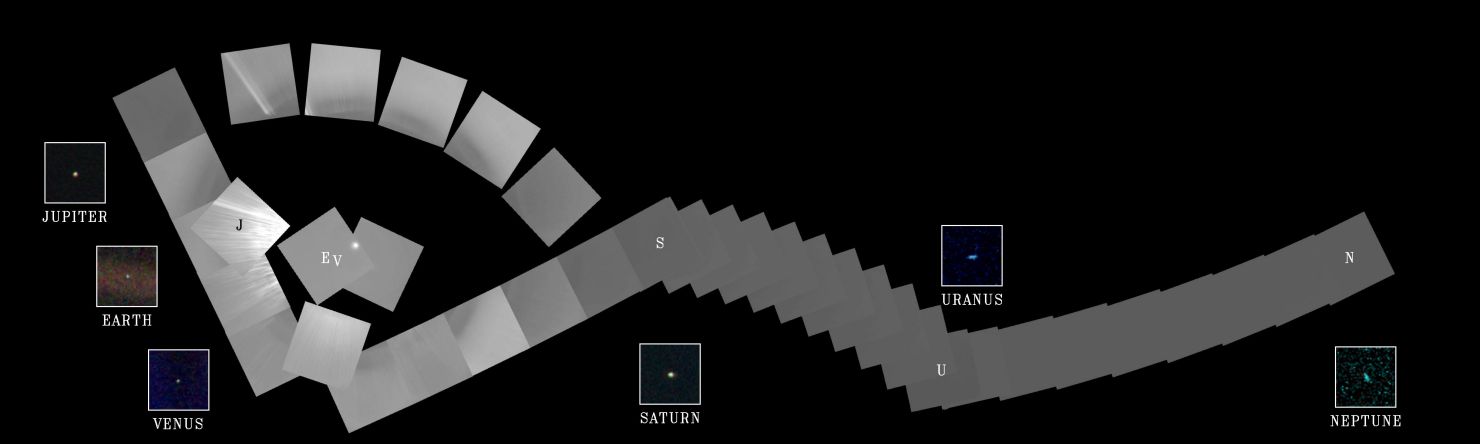
On another Valentine's Day (February 14, 1990), cruising four billion miles from the Sun, the Voyager 1 spacecraft looked back to make this first ever family portrait of our Solar System. The complete portrait is a 60 frame mosaic made from a vantage point 32 degrees above the ecliptic plane. Voyager's wide angle camera frames sweep through the inner Solar System (far left) linking up with gas giant Neptune, at the time the Solar System's outermost planet (scroll right). Positions for Venus, Earth, Jupiter, Saturn, Uranus, and Neptune are indicated by the corresponding letters while the Sun is the bright spot near the center of the circle of frames. The inset frames for each of the planets are from Voyager's narrow field camera. Unseen in the portrait are Mercury, too close to the Sun to be detected, and Mars, unfortunately hidden by sunlight scattered in the camera's optical system. Small, faint Pluto's position was not covered.