The Sun
The Sun is a yellow dwarf star (G2V), about 4.6 billion years old, and the dominant gravitational force in the Solar System. It has a diameter of roughly 1.4 million kilometers and contains around 99.8% of the Solar System’s mass. Nuclear fusion in its core converts hydrogen into helium, producing energy that warms the planets. Above the core lie the radiative and convective zones, followed by the visible photosphere (~5,500 °C), the chromosphere, and the much hotter corona (~2 million °C).
Source: science.nasa.gov
APODs including "The Sun"
Comet Ikeya-Zhang Meets The ISS
26/04/2002
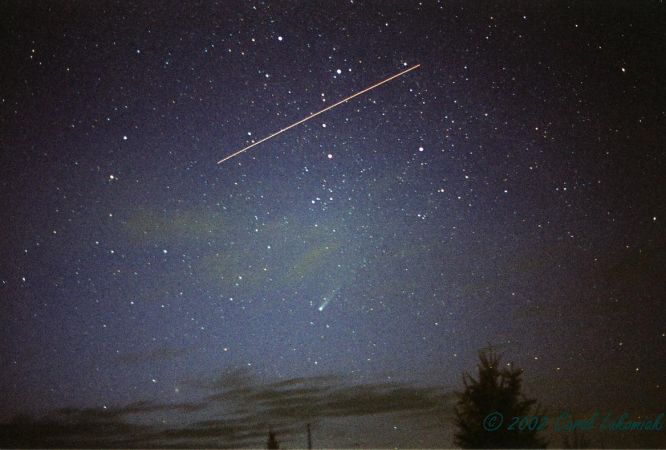
Still catching the Sun's rays, the International Space Station (ISS) cruises across the early evening sky above Tomahawk, Wisconsin, USA. Recorded on April 9 around 9 pm CDT in a 30 second exposure, the sunlit space station traced this bright streak moving east (right) through the constellation Cassiopeia. Below lies Comet Ikeya-Zhang sporting a visible tail. But while this photogenic comet is now fading from view, the ISS will be getting brighter. Hours after this picture was taken, the Space Shuttle Atlantis docked with the ISS, bringing another structure to add to the growing orbital outpost.