The Sun
The Sun is a yellow dwarf star (G2V), about 4.6 billion years old, and the dominant gravitational force in the Solar System. It has a diameter of roughly 1.4 million kilometers and contains around 99.8% of the Solar System’s mass. Nuclear fusion in its core converts hydrogen into helium, producing energy that warms the planets. Above the core lie the radiative and convective zones, followed by the visible photosphere (~5,500 °C), the chromosphere, and the much hotter corona (~2 million °C).
Source: science.nasa.gov
APODs including "The Sun"
Planets Over Stonehenge
09/05/2002
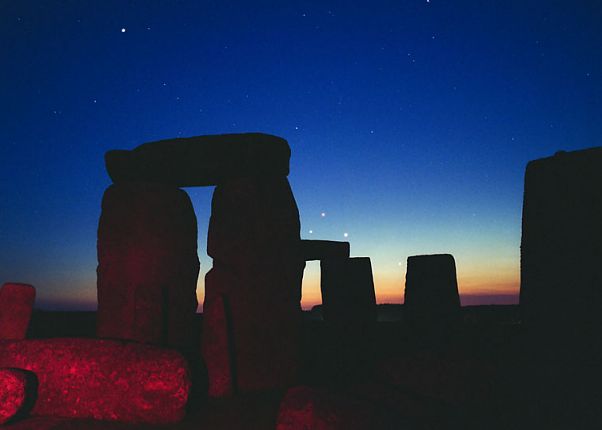
Stonehenge, four thousand year old monument to the Sun, provides an appropriate setting for this delightful snapshot of the Sun's children gathering in planet Earth's sky. While the massive stone structure dates from around 2000 B.C., this arrangement of the visible planets was recorded only a few days ago on the evening of May 4th, 2002 A.D. Bright Jupiter stands highest above the horizon at the upper left. A remarkable, almost equilateral triangle formed by Saturn (left), Mars (top), and Venus (right) is placed just above the stones near picture center. Fighting the glow of the setting sun, Mercury can be spotted closest to the horizon, below and right of the planetary triad. Still easy to enjoy for casual sky gazers, this photogenic and slowly shifting planetary grouping will be joined by a young crescent Moon beginning Monday, May 13.