The Sun
The Sun is a yellow dwarf star (G2V), about 4.6 billion years old, and the dominant gravitational force in the Solar System. It has a diameter of roughly 1.4 million kilometers and contains around 99.8% of the Solar System’s mass. Nuclear fusion in its core converts hydrogen into helium, producing energy that warms the planets. Above the core lie the radiative and convective zones, followed by the visible photosphere (~5,500 °C), the chromosphere, and the much hotter corona (~2 million °C).
Source: science.nasa.gov
APODs including "The Sun"
Tail Wags of Comet Ikeya-Zhang
15/05/2002
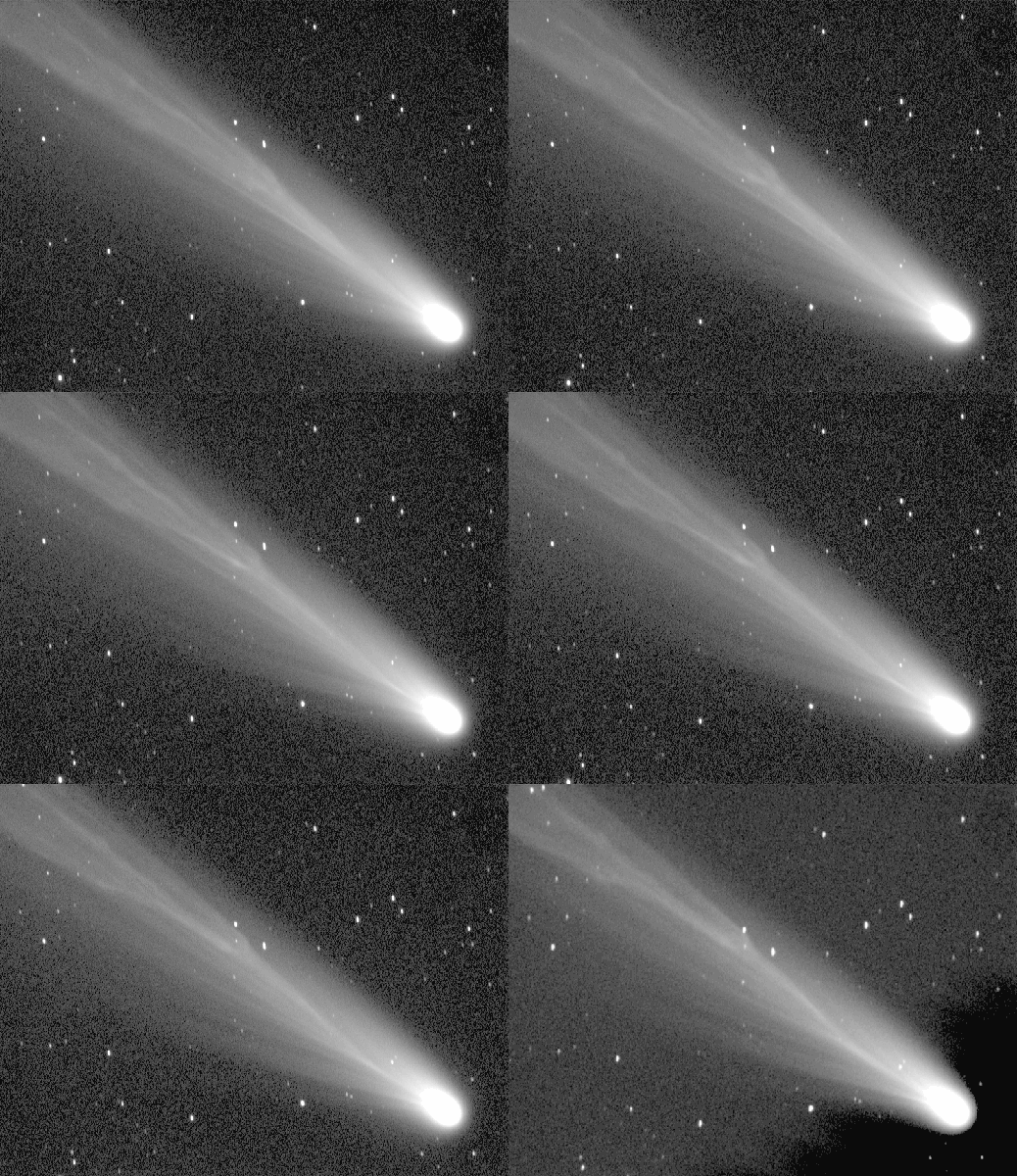
As Comet Ikeya-Zhang approached the Sun two months ago, it developed a complex blue ion tail. The tail was composed of ions that boiled off the nucleus and were pushed away from the Sun by the out-flowing fast-moving particles of the solar wind. Complexity in the tail is created by comet nucleus rotation, variability in the comet surface evaporation rate, and variability of the Sun's magnetic field and solar wind. The above animation documents how Comet Ikeya-Zhang's tail changed over 30 minutes in ten consecutive 3-minute exposures on March 11. Comet Ikeya Zhang is now fading as it heads back to the outer Solar System. It should remain visible through a small telescope for another month.