The Sun
The Sun is a yellow dwarf star (G2V), about 4.6 billion years old, and the dominant gravitational force in the Solar System. It has a diameter of roughly 1.4 million kilometers and contains around 99.8% of the Solar System’s mass. Nuclear fusion in its core converts hydrogen into helium, producing energy that warms the planets. Above the core lie the radiative and convective zones, followed by the visible photosphere (~5,500 °C), the chromosphere, and the much hotter corona (~2 million °C).
Source: science.nasa.gov
APODs including "The Sun"
Our Busy Solar System
24/07/2002
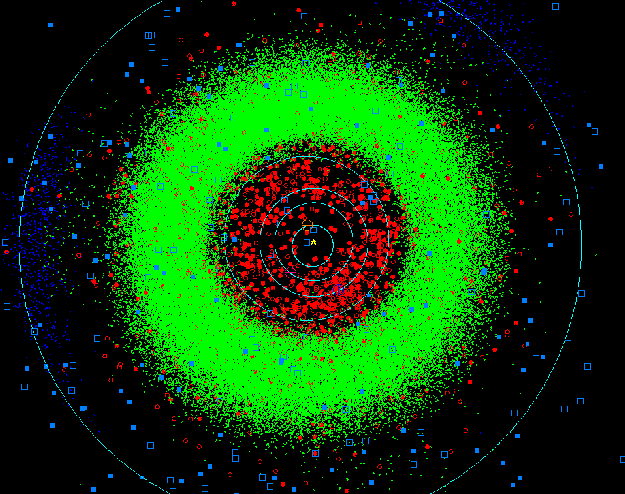
Our Solar System is a busy place. Although the major planets get the most press, a swarm of rocks, comets, and asteroids also exist. The above plot shows the placement of known inner Solar System objects on 2002 July 20. The light blue lines indicate the orbits of planets. The green dots indicate asteroids, officially known as minor planets. The red dots indicate asteroids that come within 1.3 Earth-Sun distances (AU) of the Sun and so pose an increased (although small) collision risk with the Earth. Comets appear as dark blue squares, while dark blue points are Jupiter Trojans, asteroids that orbit just ahead of, or just behind Jupiter. Note that most asteroids of the inner Solar System orbit between Mars and Jupiter in the main asteroid belt. Every day this plot shifts with objects nearer the Sun typically shifting the most. The current locations of these objects can be found here.