The Sun
The Sun is a yellow dwarf star (G2V), about 4.6 billion years old, and the dominant gravitational force in the Solar System. It has a diameter of roughly 1.4 million kilometers and contains around 99.8% of the Solar System’s mass. Nuclear fusion in its core converts hydrogen into helium, producing energy that warms the planets. Above the core lie the radiative and convective zones, followed by the visible photosphere (~5,500 °C), the chromosphere, and the much hotter corona (~2 million °C).
Source: science.nasa.gov
APODs including "The Sun"
A Setting Sun Trail
29/07/2002
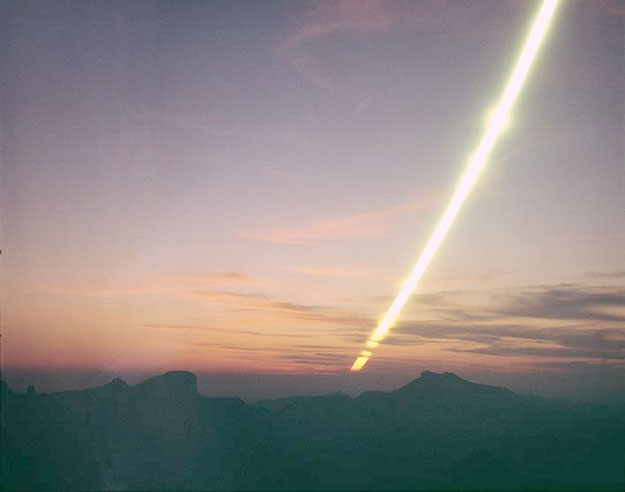
The Sun appears to move on the sky because the Earth rotates. The extreme brightness of the Sun, however, makes it difficult to capture a sun-trail -- the path the Sun traces on the sky. To capture the above picture, a very dark filter covered the camera lens for most of the time, allowing only a trifle of light from the bright Sun to peek through. Just after the Sun had dipped below the horizon but before it was completely dark, the thick filter was removed and the pretty foreground scene was captured. Slight flares appeared when the Sun went behind thin clouds. Star-trails and planet-trails are much easier to image, and a similar Moon trail has also recently been imaged.