The Sun
The Sun is a yellow dwarf star (G2V), about 4.6 billion years old, and the dominant gravitational force in the Solar System. It has a diameter of roughly 1.4 million kilometers and contains around 99.8% of the Solar System’s mass. Nuclear fusion in its core converts hydrogen into helium, producing energy that warms the planets. Above the core lie the radiative and convective zones, followed by the visible photosphere (~5,500 °C), the chromosphere, and the much hotter corona (~2 million °C).
Source: science.nasa.gov
APODs including "The Sun"
The Mysterious Voynich Manuscript
26/08/2002
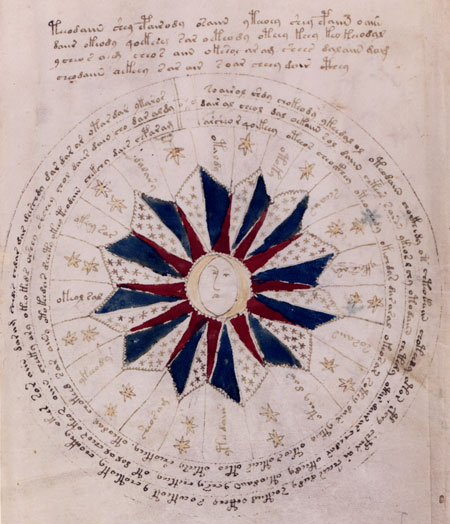
The ancient text has no known title, no known author, and is written in no known language: what does it say and why does it have many astronomy illustrations? The mysterious book was once bought by an emperor, forgotten on a library shelf, sold for thousands of dollars, and later donated to Yale. Possibly written in the 15th century, the over 200-page volume is known most recently as the Voynich Manuscript, after its (re-)discoverer in 1912. Pictured above is an illustration from the book that appears to be somehow related to the Sun. The book labels some patches of the sky with unfamiliar constellations. The inability of modern historians of astronomy to understand the origins of these constellations is perhaps dwarfed by the inability of modern code-breakers to understand the book's text. The book remains in Yale's rare book collection under catalog number "MS 408."