The Sun
The Sun is a yellow dwarf star (G2V), about 4.6 billion years old, and the dominant gravitational force in the Solar System. It has a diameter of roughly 1.4 million kilometers and contains around 99.8% of the Solar System’s mass. Nuclear fusion in its core converts hydrogen into helium, producing energy that warms the planets. Above the core lie the radiative and convective zones, followed by the visible photosphere (~5,500 °C), the chromosphere, and the much hotter corona (~2 million °C).
Source: science.nasa.gov
APODs including "The Sun"
Jupiter, Moons and Bees
25/09/2002
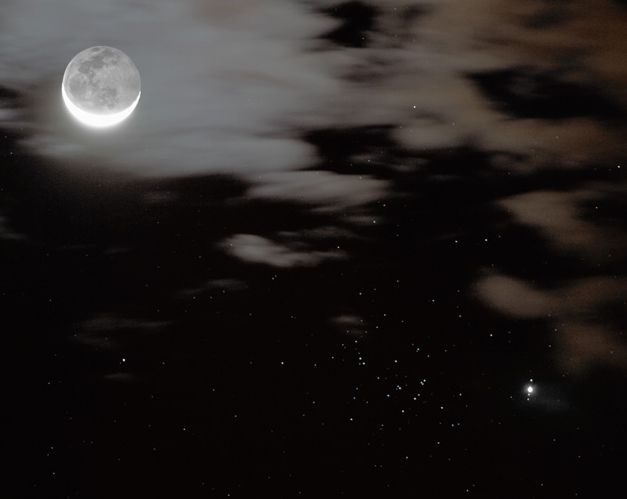
Rising before the Sun on September 4, Jupiter and an old cresent Moon gathered in the dim constellation of Cancer. Watching from a hillside near Austin, Texas, planet Earth, astrophotographer Russell Croman recorded this view of their passing as clouds gracefully dimmed the brilliant moonlight. Earthshine illuminates the lunar night side and on close inspection, bright Jupiter at the lower right appears tightly flanked by its own four large Galilean moons. Next to Jupiter lies a loose swarm of stars just below the clouds. The stars are the brighter members of the nearby star cluster M44, popularly known as the Beehive cluster. Croman's remarkable digital image has been processed only slightly to improve the visibility of the earthshine region and Jupiter's moons.