The Sun
The Sun is a yellow dwarf star (G2V), about 4.6 billion years old, and the dominant gravitational force in the Solar System. It has a diameter of roughly 1.4 million kilometers and contains around 99.8% of the Solar System’s mass. Nuclear fusion in its core converts hydrogen into helium, producing energy that warms the planets. Above the core lie the radiative and convective zones, followed by the visible photosphere (~5,500 °C), the chromosphere, and the much hotter corona (~2 million °C).
Source: science.nasa.gov
APODs including "The Sun"
V838 Mon: Mystery Star
03/10/2002
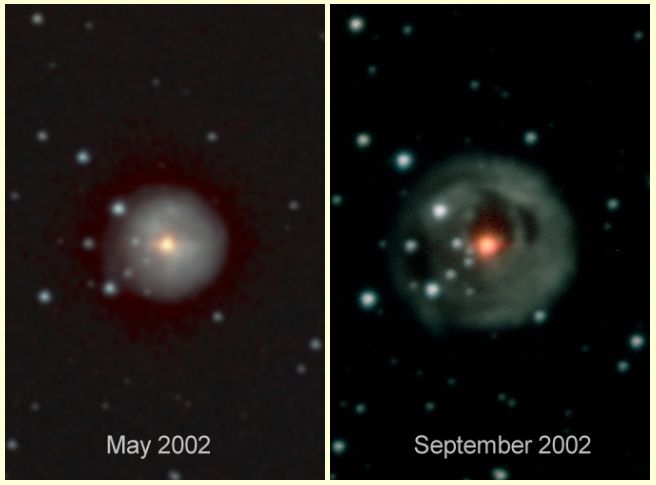
A leading candidate for the most mysterious star found in recent times is variable star V838 Monocerotis. At a distance of about 8,000 light-years, V838 Mon was discovered to be in outburst in January of this year. Initially thought to be a familiar type of classical nova, astronomers quickly realized that instead, V838 Mon may be a totally new addition to the astronomical zoo. Observations indicate that the erupting star transformed itself over a period of months from a small under-luminous star a little hotter than the Sun, to a highly-luminous, cool supergiant star undergoing rapid and complex brightness changes. The transformation defies the conventional understanding of stellar life cycles. A most notable feature of V838 Mon is the "expanding" nebula which now appears to surround it. Seen above in two separate images from the South African Astronomical Observatory's 1 meter telescope, the nebula is probably a light echo from shells of formerly unseen material lost by the star during its previous evolution. Light-years in diameter, the shells progressively reflect the light from V838 Mon's outbursts, providing an opportunity to look back at the history of this remarkable star's behaviour.