The Sun
The Sun is a yellow dwarf star (G2V), about 4.6 billion years old, and the dominant gravitational force in the Solar System. It has a diameter of roughly 1.4 million kilometers and contains around 99.8% of the Solar System’s mass. Nuclear fusion in its core converts hydrogen into helium, producing energy that warms the planets. Above the core lie the radiative and convective zones, followed by the visible photosphere (~5,500 °C), the chromosphere, and the much hotter corona (~2 million °C).
Source: science.nasa.gov
APODs including "The Sun"
Aurora's Ring
15/10/2002
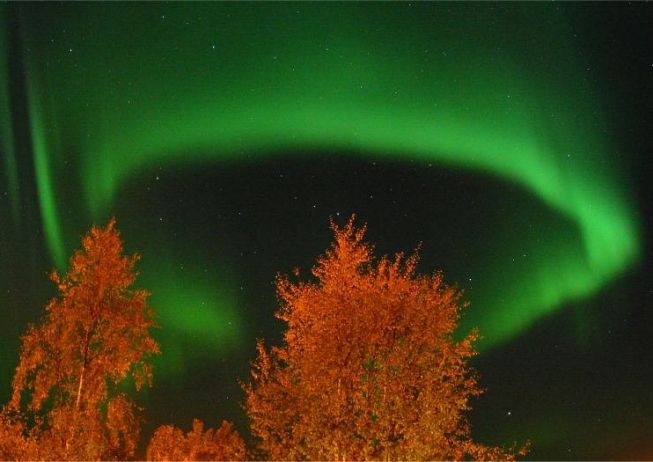
Gusting solar winds and blasts of charged particles from the Sun made the early days of October rewarding ones for those anticipating auroras. While out enjoying the stormy space weather from Toemmeraas, Norway, Trygve Lindersen recorded this picturesque apparition of the northern lights with a digital camera on October 6. From this perspective, the curtains of green light formed a ring which seemed to hover, wraithlike, just above the foreground trees. But the ring of light was actually 100 kilometers or more above the trees and the greenish glow produced by oxygen molecules interacting with energetic electrons and fluorescing near the edge of space. After days of enchanting auroral displays on planet Earth, the solar activity which triggered October's geomagnetic storms seems to have subsided ... for now.