The Sun
The Sun is a yellow dwarf star (G2V), about 4.6 billion years old, and the dominant gravitational force in the Solar System. It has a diameter of roughly 1.4 million kilometers and contains around 99.8% of the Solar System’s mass. Nuclear fusion in its core converts hydrogen into helium, producing energy that warms the planets. Above the core lie the radiative and convective zones, followed by the visible photosphere (~5,500 °C), the chromosphere, and the much hotter corona (~2 million °C).
Source: science.nasa.gov
APODs including "The Sun"
At the Center of the Milky Way
18/10/2002
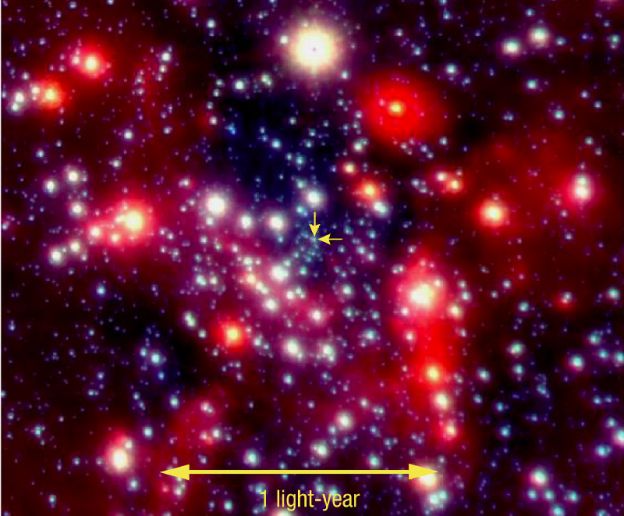
At the center of our Milky Way Galaxy lies a black hole with over 2 million times the mass of the Sun. Once a controversial claim, this astounding conclusion is now virtually inescapable and based on observations of stars orbiting very near the galactic center. Using one of the Paranal Observatory's very large telescopes and the sophisticated infrared camera NACO, astronomers patiently followed the orbit of a particular star, designated S2, as it came within about 17 light-hours of the center of the Milky Way (17 light-hours is only about 3 times the radius of Pluto's orbit). Their results convincingly show that S2 is moving under the influence of the enormous gravity of an unseen object which must be extremely compact -- a supermassive black hole. This deep NACO near-infrared image shows the crowded inner 2 light-years of the Milky Way with the exact position of the galactic center indicated by arrows. NACO's ability to track stars so close to the galactic center can accurately measure the black hole's mass and perhaps even provide an unprecedented test of Einstein's theory of gravity as astronomers watch a star orbit a supermassive black hole.