The Sun
The Sun is a yellow dwarf star (G2V), about 4.6 billion years old, and the dominant gravitational force in the Solar System. It has a diameter of roughly 1.4 million kilometers and contains around 99.8% of the Solar System’s mass. Nuclear fusion in its core converts hydrogen into helium, producing energy that warms the planets. Above the core lie the radiative and convective zones, followed by the visible photosphere (~5,500 °C), the chromosphere, and the much hotter corona (~2 million °C).
Source: science.nasa.gov
APODs including "The Sun"
Moon, Mars, Venus, and Spica
04/12/2002
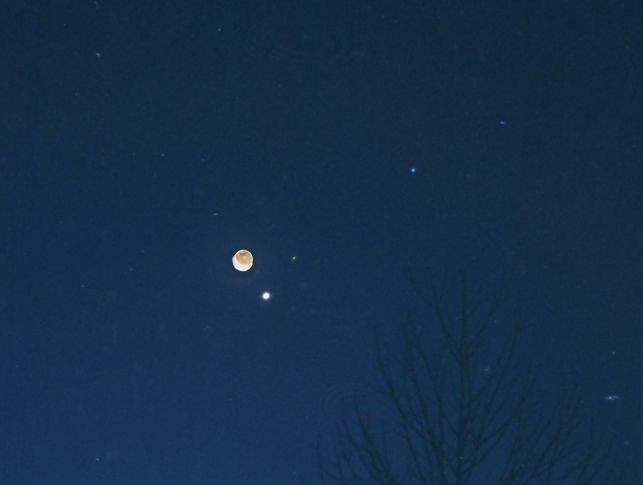
Gliding toward today's total eclipse of the Sun, the crescent Moon has been rising early, just before dawn. And as a prelude to its close solar alignment, the Moon also completed a lovely celestial triangle, closing with bright planets Mars and Venus on the morning of December 1. While the total solar eclipse can only be seen from a narrow corridor, skygazers around the globe could appreciate this lunar-planetary conjunction. This view is from near Nashville Tennessee, USA, and finds brilliant Venus at the lowest corner of the triangle with a much fainter Mars immediately to the right of the Moon. The Moon's sunlit crescent is overexposed, but details of the lunar night side are revealed by earthshine. Above and to the right of the trio is Spica, brightest star in the constellation Virgo.