The Sun
The Sun is a yellow dwarf star (G2V), about 4.6 billion years old, and the dominant gravitational force in the Solar System. It has a diameter of roughly 1.4 million kilometers and contains around 99.8% of the Solar System’s mass. Nuclear fusion in its core converts hydrogen into helium, producing energy that warms the planets. Above the core lie the radiative and convective zones, followed by the visible photosphere (~5,500 °C), the chromosphere, and the much hotter corona (~2 million °C).
Source: science.nasa.gov
APODs including "The Sun"
The Crown of the Sun
13/12/2002
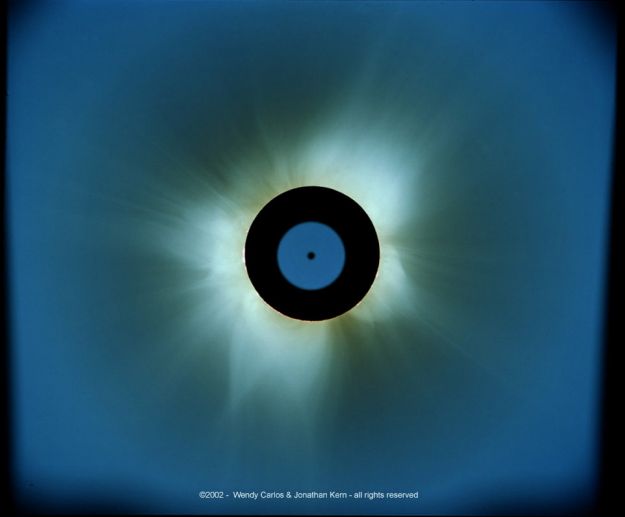
During a total solar eclipse, the Sun's extensive outer atmosphere or corona is an awesome and inspirational sight. Yet the subtle shades and shimmering features of the corona that engage the eye span a brightness range of over 10,000 to 1, making them notoriously difficult to capture in a photograph. Still, this single five second exposure comes very close to revealing the crown of the Sun in all its glory. The color picture was taken with a specially built coronal camera and telescope during the December 4th total eclipse from Messina, South Africa. The camera's design incorporates a precisely made filter whose density, or ability to block light, decreases markedly with distance from the filter center, compensating for the difference between the brighter inner portion of the corona at the Sun's edge and the much fainter outer regions. The central spot in the image corresponds to a calibration window centered on the eclipsed Sun.