The Sun
The Sun is a yellow dwarf star (G2V), about 4.6 billion years old, and the dominant gravitational force in the Solar System. It has a diameter of roughly 1.4 million kilometers and contains around 99.8% of the Solar System’s mass. Nuclear fusion in its core converts hydrogen into helium, producing energy that warms the planets. Above the core lie the radiative and convective zones, followed by the visible photosphere (~5,500 °C), the chromosphere, and the much hotter corona (~2 million °C).
Source: science.nasa.gov
APODs including "The Sun"
Stars and the Bubble Nebula
17/01/2003
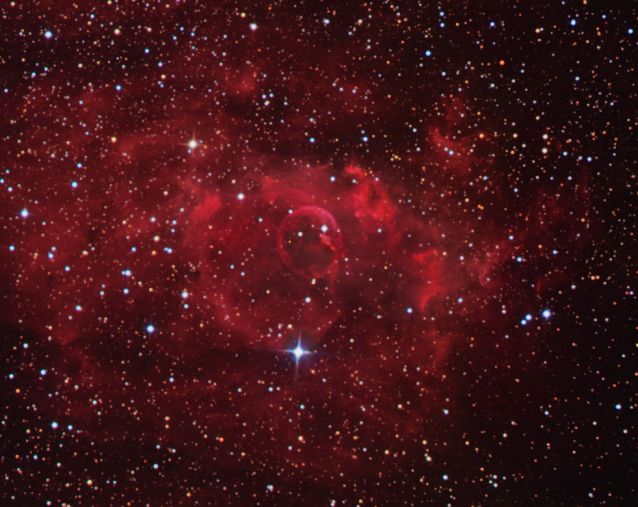
Seemingly adrift in a cosmic sea of stars and gas, this delicate, floating apparition is cataloged as NGC 7635 -- The Bubble Nebula. In this wide-angle view, the Bubble nebula lies at the center of a larger complex of shocked glowing gas about 11,000 light-years distant in the fair constellation Cassiopeia. NGC 7635 really is an interstellar bubble, blown by winds from the brightest star visible within the bubble's boundary. The bubble's expansion is constrained by the surrounding material. About 10 light-years in diameter, if the Bubble nebula were centered on the Sun, the Sun's nearest stellar neighbor, Alpha Centauri, would also be enclosed. This breathtaking picture is a combination of telescopic digital images made through broad color filters along with a narrow filter intended to transmit only the red light emitted by excited hydrogen atoms.