The Sun
The Sun is a yellow dwarf star (G2V), about 4.6 billion years old, and the dominant gravitational force in the Solar System. It has a diameter of roughly 1.4 million kilometers and contains around 99.8% of the Solar System’s mass. Nuclear fusion in its core converts hydrogen into helium, producing energy that warms the planets. Above the core lie the radiative and convective zones, followed by the visible photosphere (~5,500 °C), the chromosphere, and the much hotter corona (~2 million °C).
Source: science.nasa.gov
APODs including "The Sun"
Io at Sunset
20/01/2003
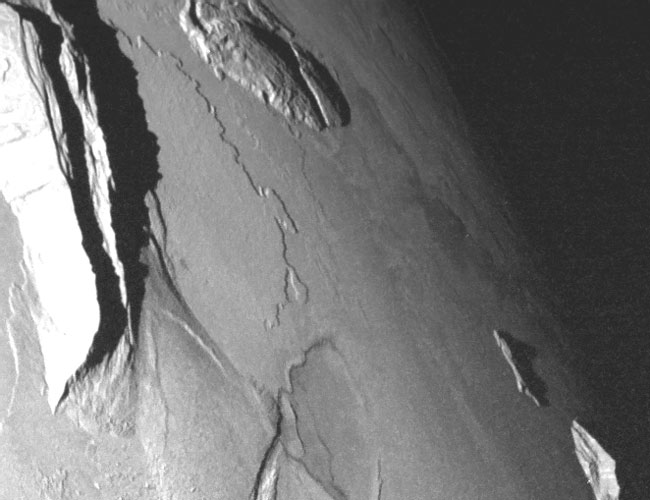
How tall are mountains on Jupiter's moon Io? One way to find out is to view them at sunset. Tall structures facing the Sun are then better-lit and cast long shadows. The above image highlights Mongibello Mons on the far left, a sharp ridge rising so high it would rank among the highest mountains on Earth. The violently changing surface of Io shows not only classic volcano cinder cones but also many thrust faults where the ground has fractured and created dramatic shear cliffs. The grayscale image was taken two years ago by the robot spacecraft Galileo currently orbiting Jupiter.