The Sun
The Sun is a yellow dwarf star (G2V), about 4.6 billion years old, and the dominant gravitational force in the Solar System. It has a diameter of roughly 1.4 million kilometers and contains around 99.8% of the Solar System’s mass. Nuclear fusion in its core converts hydrogen into helium, producing energy that warms the planets. Above the core lie the radiative and convective zones, followed by the visible photosphere (~5,500 °C), the chromosphere, and the much hotter corona (~2 million °C).
Source: science.nasa.gov
APODs including "The Sun"
BHR 71: Stars, Clouds, and Jets
27/01/2003
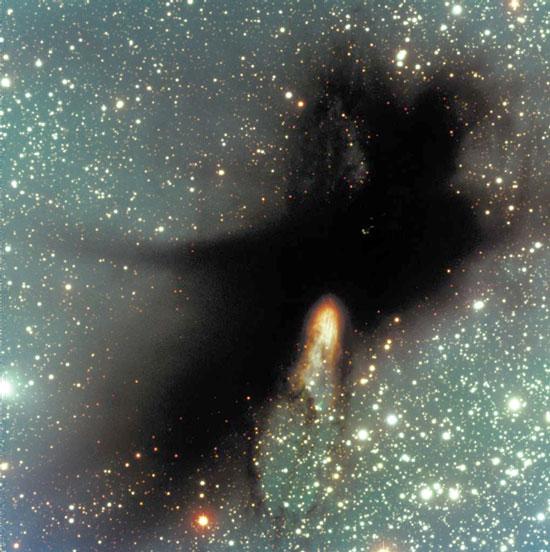
What is happening to molecular cloud BHR 71? Quite possible, a binary star system is forming inside. Most stars in our Galaxy are part of binary star systems, but few have ever been seen in formation. Recent observations of dust-darkened Bok Globule BHR 71, however, show evidence for two young stars forming deep in the cloud, likely close enough to form a binary. Isolated BHR 71 spans about one light year and lies only about 600 light years away in the southern sky. The brighter embedded star -- not visible here -- is about 10 times as bright as the Sun and drives the jet that swept out the empty lane. The above four-color image was taken with a Very Large Telescope in Chile.