The Sun
The Sun is a yellow dwarf star (G2V), about 4.6 billion years old, and the dominant gravitational force in the Solar System. It has a diameter of roughly 1.4 million kilometers and contains around 99.8% of the Solar System’s mass. Nuclear fusion in its core converts hydrogen into helium, producing energy that warms the planets. Above the core lie the radiative and convective zones, followed by the visible photosphere (~5,500 °C), the chromosphere, and the much hotter corona (~2 million °C).
Source: science.nasa.gov
APODs including "The Sun"
Comet NEAT Approaches the Sun
10/02/2003
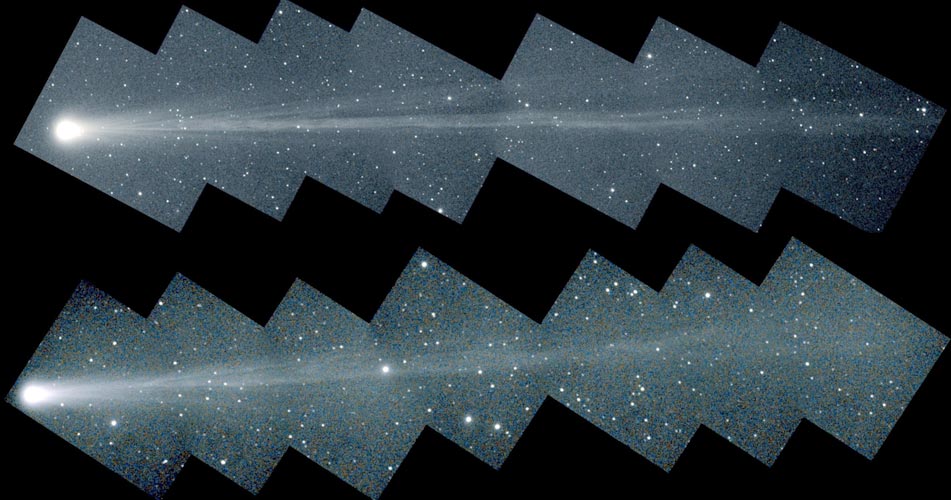
A comet may likely become visible to the unaided eye over the next few days above the horizon where the Sun has just set. Comet NEAT (C/ 2002 V1), discovered last November, has brightened dramatically as it approached the Sun. Over the next few days, the quickly setting comet could appear as bright as second magnitude. On February 18 it will round the Sun well within the orbit of Mercury. During surrounding days, the Sun's glare will effectively hide the comet to human observers. It is quite probable, though, that Comet NEAT will standout prominently in images taken by the Sun-looking SOHO satellite. Pictured above, Comet NEAT's complex and developing tail was photographed on January 29 (top) and February 2. Sky enthusiasts should remember to never look directly at the Sun. APOD Update: APOD mirror now on-line from Australia.