The Sun
The Sun is a yellow dwarf star (G2V), about 4.6 billion years old, and the dominant gravitational force in the Solar System. It has a diameter of roughly 1.4 million kilometers and contains around 99.8% of the Solar System’s mass. Nuclear fusion in its core converts hydrogen into helium, producing energy that warms the planets. Above the core lie the radiative and convective zones, followed by the visible photosphere (~5,500 °C), the chromosphere, and the much hotter corona (~2 million °C).
Source: science.nasa.gov
APODs including "The Sun"
Comet NEAT in Southern Skies
06/03/2003
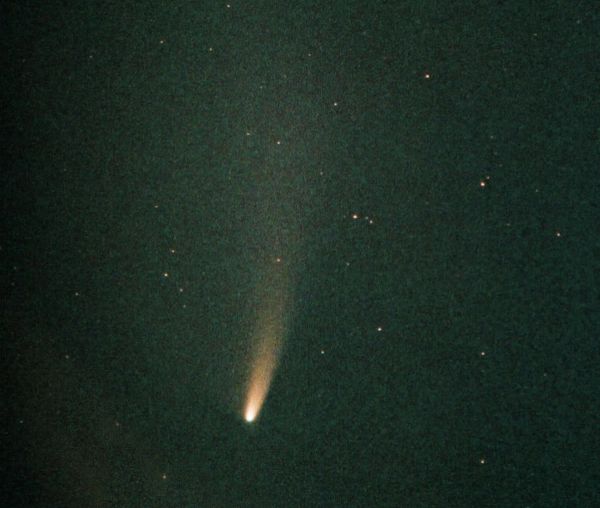
After last month's dramatic swoop past the Sun, Comet NEAT (C/2002 V1) appeared as a naked-eye comet, emerging from the evening twilight in planet Earth's southern skies. On March 1st, New Zealand photographer Noel Munford captured this telephoto view of the outbound comet close to the southwestern horizon against the faint stars of the constellation Sculptor. He reports that the picture is a good representation of the comet's visual appearance on that date and estimates the impressive tail to be five or six degrees long. Discovered last November as part of the Near-Earth Asteroid Tracking program, there was some speculation that this comet would not survive its close encounter with the Sun. However, Comet NEAT is now returning to the outer solar system, diving southward and fading fast.