The Sun
The Sun is a yellow dwarf star (G2V), about 4.6 billion years old, and the dominant gravitational force in the Solar System. It has a diameter of roughly 1.4 million kilometers and contains around 99.8% of the Solar System’s mass. Nuclear fusion in its core converts hydrogen into helium, producing energy that warms the planets. Above the core lie the radiative and convective zones, followed by the visible photosphere (~5,500 °C), the chromosphere, and the much hotter corona (~2 million °C).
Source: science.nasa.gov
APODs including "The Sun"
Mercury Transits the Sun
13/05/2003
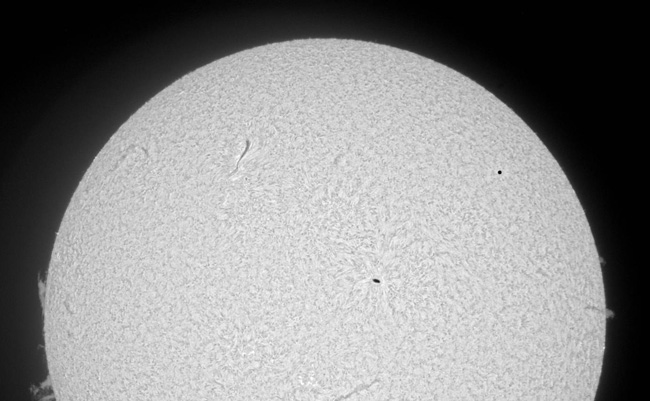
How big is the Sun? The Sun is not only larger than any planet, it is larger than all of the planets put together. The Sun accounts for about 99.9 percent of all the mass in its Solar System. Merely stating the Sun's diameter is about 1,400,000 kilometers does not do it justice. Last week a chance to gain visual size perspective occurred when planet Mercury made a rare crossing in front to Sun. Mercury, a planet over a third of the diameter of our Earth, is the dark dot on the upper right. In comparison to the Sun, Mercury is so small it is initially hard to spot. Also visible on the Sun are dark circular sunspots, bright plages, and dark elongated prominences -- many of which are larger than Mercury. The above contrast-enhanced picture was captured last week from France.