The Sun
The Sun is a yellow dwarf star (G2V), about 4.6 billion years old, and the dominant gravitational force in the Solar System. It has a diameter of roughly 1.4 million kilometers and contains around 99.8% of the Solar System’s mass. Nuclear fusion in its core converts hydrogen into helium, producing energy that warms the planets. Above the core lie the radiative and convective zones, followed by the visible photosphere (~5,500 °C), the chromosphere, and the much hotter corona (~2 million °C).
Source: science.nasa.gov
APODs including "The Sun"
NGC 1818: Pick A Star
31/05/2003
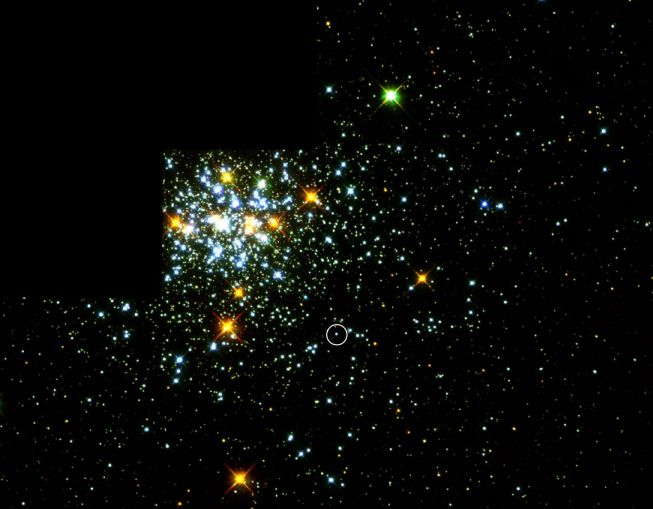
This is NGC 1818, a youthful, glittering cluster of 20,000 stars residing in the Large Magellanic Cloud, 180,000 light-years away. Pick a star. Any star. Astronomers might pick the unassuming bluish-white one (circled) which appears to be a hot newly formed white dwarf star. What makes it so interesting? The standard astronomical wisdom suggests that stars over 5 times as massive as the sun rapidly exhaust their nuclear fuel and end their lives in a spectacular supernova explosion. With less than this critical mass they evolve into red giants, pass through a relatively peaceful planetary nebula phase, and calmly fade away as white dwarf stars like this one. Except that as a member of the NGC 1818 cluster, this new white dwarf would have evolved from a red giant star over 7.6 times as massive as the sun -- which should have exploded! Its discovery will likely force astronomers to revise the limiting mass estimate for supernovae upward.