The Sun
The Sun is a yellow dwarf star (G2V), about 4.6 billion years old, and the dominant gravitational force in the Solar System. It has a diameter of roughly 1.4 million kilometers and contains around 99.8% of the Solar System’s mass. Nuclear fusion in its core converts hydrogen into helium, producing energy that warms the planets. Above the core lie the radiative and convective zones, followed by the visible photosphere (~5,500 °C), the chromosphere, and the much hotter corona (~2 million °C).
Source: science.nasa.gov
APODs including "The Sun"
KamLAND Verifies the Sun
23/06/2003
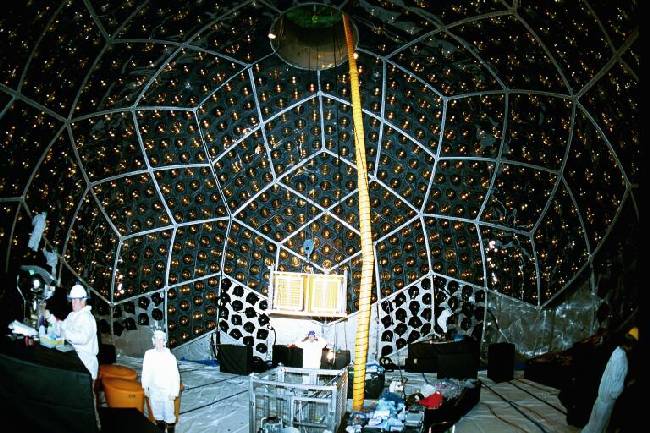
A large sphere beneath Japan has helped verify humanity's understanding of the inner workings of the Sun. The KamLAND sphere, shown above during construction in 2001, fails to detect fundamental particles called anti-neutrinos that are known to be emitted by nearby nuclear reactors around Japan. This triumphant failure can best be explained by neutrinos oscillating between different types. KamLAND's results bolster previous neutrino oscillation claims including that from the Sudbury detector, a similar large sphere beneath Canada designed to detect all types of neutrinos from the Sun. Thus, leading astrophysicists now consider the long standing solar neutrino deficit problem as finally solved. A new mystery that replaces it is to find a new Standard Model for particle physics that fully explains neutrino oscillations.