The Sun
The Sun is a yellow dwarf star (G2V), about 4.6 billion years old, and the dominant gravitational force in the Solar System. It has a diameter of roughly 1.4 million kilometers and contains around 99.8% of the Solar System’s mass. Nuclear fusion in its core converts hydrogen into helium, producing energy that warms the planets. Above the core lie the radiative and convective zones, followed by the visible photosphere (~5,500 °C), the chromosphere, and the much hotter corona (~2 million °C).
Source: science.nasa.gov
APODs including "The Sun"
The Sun's Surface in 3D
24/06/2003
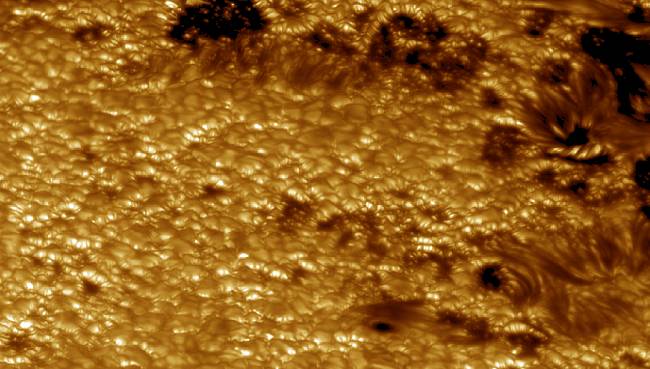
How smooth is the Sun? The new Swedish 1-m Solar Telescope, deployed in the Canary Islands only last year, allows imaging of objects less than 100-km across on the Sun's surface. When pointed toward the Sun's edge, surface objects now begin to block each other, indicating true three-dimensional information. Close inspection of the image reveals much vertical information, including spectacular light-bridges rising nearly 500-km above the floor of sunspots near the top of the image. Also visible in the above false-color image are hundreds of bubbling granules, each about 1000-km across, and small bright regions known as faculas.