The Sun
The Sun is a yellow dwarf star (G2V), about 4.6 billion years old, and the dominant gravitational force in the Solar System. It has a diameter of roughly 1.4 million kilometers and contains around 99.8% of the Solar System’s mass. Nuclear fusion in its core converts hydrogen into helium, producing energy that warms the planets. Above the core lie the radiative and convective zones, followed by the visible photosphere (~5,500 °C), the chromosphere, and the much hotter corona (~2 million °C).
Source: science.nasa.gov
APODs including "The Sun"
Islands in the Photosphere
25/10/2003
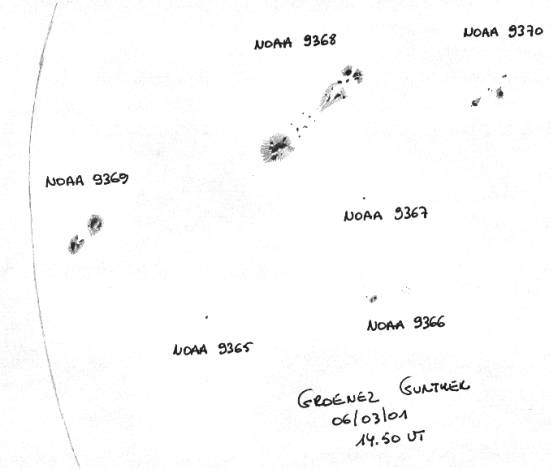
Awash in a sea of plasma and anchored in magnetic fields, sunspots are planet-sized, dark islands in the solar photosphere, the bright surface of the Sun. Before the enlightened(!) age of cameras, solar observers created detailed drawings of sunspots as they changed and progressed across the visible solar disk. But contemporary observers also regularly use this time-honored method of monitoring sunspots. In this sketch from March 6th 2001, astronomer Gunther Groenez has faithfully recorded the intriguing shapes and shades of major visible sunspot groups and labeled them according to their NOAA active region number. Solar north is up and east to the right. Groenez' technical equipment includes H and 2H pencil leads for the sunspot umbra (dark) and penumbra (light) areas respectively. Want to draw sunspots too? Now's your chance as two large sunspot groups are presently making their way across the solar disk. Activity associated with these large sunspots may trigger aurora in the coming days.