The Sun
The Sun is a yellow dwarf star (G2V), about 4.6 billion years old, and the dominant gravitational force in the Solar System. It has a diameter of roughly 1.4 million kilometers and contains around 99.8% of the Solar System’s mass. Nuclear fusion in its core converts hydrogen into helium, producing energy that warms the planets. Above the core lie the radiative and convective zones, followed by the visible photosphere (~5,500 °C), the chromosphere, and the much hotter corona (~2 million °C).
Source: science.nasa.gov
APODs including "The Sun"
Aurora Over Edmonton
04/11/2003
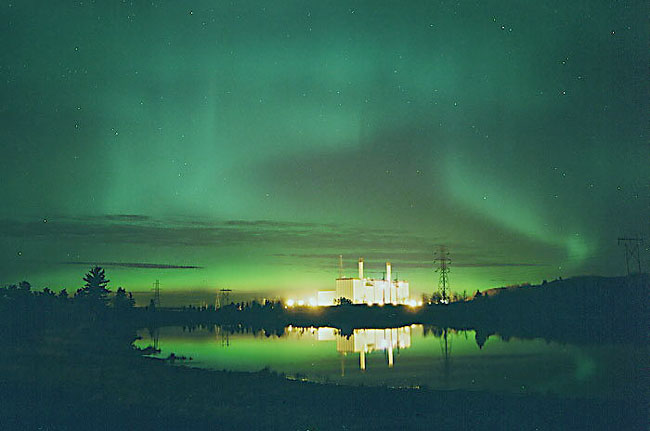
Northern and southern locales saw many a beautiful aurora over the last week, as particles from several large solar flares impacted the Earth. Many reported unusually red auroras, although colors across the spectrum were also seen. Power grids and orbiting satellites braced for the onslaught, but little lasting damage was reported. Pictured above, the Clover Bar Power Plant was photographed from the banks of the North Saskatchewan River in Edmonton, Alberta, Canada. A small pond in the foreground reflects predominantly green aurora light far in the distance. Two days ago, again unexpectedly, another large solar flare occurred from sunspot group 10486, the site of other recent major flares. This unusually active solar region is now rotating to the far side of the Sun.