The Sun
The Sun is a yellow dwarf star (G2V), about 4.6 billion years old, and the dominant gravitational force in the Solar System. It has a diameter of roughly 1.4 million kilometers and contains around 99.8% of the Solar System’s mass. Nuclear fusion in its core converts hydrogen into helium, producing energy that warms the planets. Above the core lie the radiative and convective zones, followed by the visible photosphere (~5,500 °C), the chromosphere, and the much hotter corona (~2 million °C).
Source: science.nasa.gov
APODs including "The Sun"
Light Can Twist as Well as Spin
19/11/2003
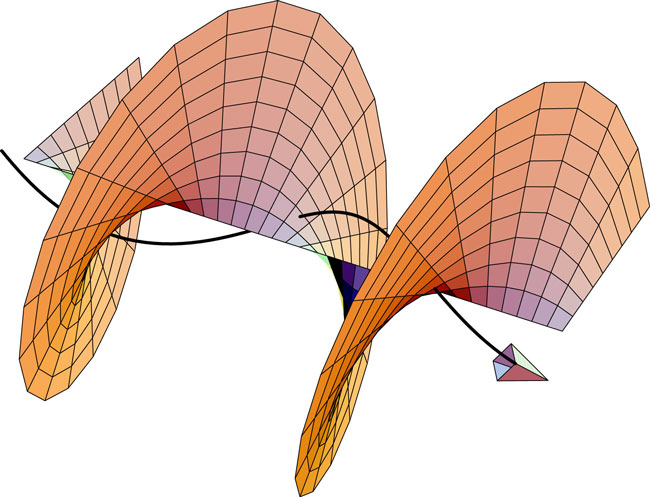
Light is more complicated than we thought. When astronomers measure light, they are usually concerned with its direction, energy, and spin polarization (sometimes). Recently, however, it has been more broadly realized that photons can also have orbital angular momentum (OAM), an attribute classically analogous to the Earth orbiting the Sun as well as spinning on its axis. Pictured above, the wave-front of a photon with OAM is shown to be twisted, in contrast to the flat plane of zero OAM light. Light with OAM might be used to increase the information content of communication or to discern specific types of astronomical sources. Passing through a common lens, light without OAM focuses to a point, whereas light with OAM focuses to a ring. Most light bouncing around the cosmos, however, is expected to have so little (or zero) OAM that the created ring is too small to measure. Even given other promising methods for measurement, exploiting OAM for astronomical discovery might be as much an issue of observational practicality as theoretical possibility. APOD Update: APOD mirror now on-line from Poland with archive in Polish.