The Sun
The Sun is a yellow dwarf star (G2V), about 4.6 billion years old, and the dominant gravitational force in the Solar System. It has a diameter of roughly 1.4 million kilometers and contains around 99.8% of the Solar System’s mass. Nuclear fusion in its core converts hydrogen into helium, producing energy that warms the planets. Above the core lie the radiative and convective zones, followed by the visible photosphere (~5,500 °C), the chromosphere, and the much hotter corona (~2 million °C).
Source: science.nasa.gov
APODs including "The Sun"
Voyager at 90 AU
20/11/2003
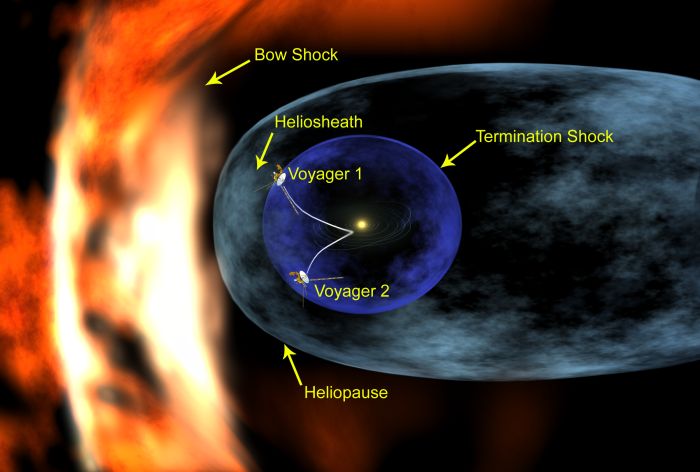
Launched in 1977, Voyager 1 is now about 12 light-hours or 90 astronomical units (AU) from the Sun, making this spacecraft humanity's most distant ambassador to the cosmos. Well beyond the orbits of the outer planets, Voyager 1 is believed to be entering the realm of deep space near the edge of the heliosphere, the region dominated by the solar wind and magnetic field. Causing some debate, new results from instruments still operating have given indications that the spacecraft could finally be encountering a fluctuating boundary known as the solar wind's termination shock. Illustrated above, the bubble-shaped termination shock is produced when the wind from the Sun slows dramatically and piles up as it runs in to the tenuous interstellar gas. Still farther out, beyond the heliopause, solar wind and interstellar gas begin to mix, while the heliosphere's motion through interstellar space creates a bow shock, analogous to a boat moving through water. Estimates are that both Voyager 1 and 2 have enough power and fuel to operate until about the year 2020. The spacecraft continue to coast toward interstellar space at over 3 AU per year.