The Sun
The Sun is a yellow dwarf star (G2V), about 4.6 billion years old, and the dominant gravitational force in the Solar System. It has a diameter of roughly 1.4 million kilometers and contains around 99.8% of the Solar System’s mass. Nuclear fusion in its core converts hydrogen into helium, producing energy that warms the planets. Above the core lie the radiative and convective zones, followed by the visible photosphere (~5,500 °C), the chromosphere, and the much hotter corona (~2 million °C).
Source: science.nasa.gov
APODs including "The Sun"
Phobos Over Mars
29/11/2003
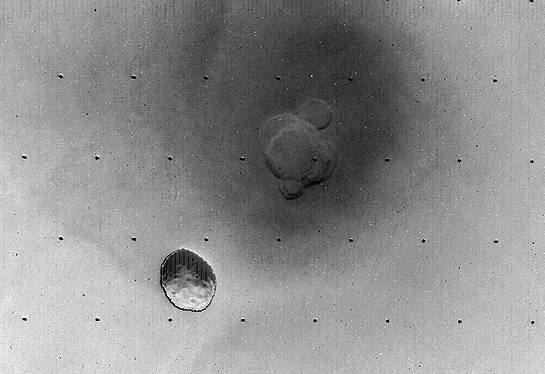
Hurtling through space a mere 3,000 miles above the Martian surface, the diminutive moon Phobos (below and left of center) was imaged against the backdrop of a large shield volcano by the Viking 2 Orbiter in 1977. This dramatic picture looks down from the Orbiter's viewpoint about 8,000 miles above the volcano, Ascraeus Mons. Phobos itself is 5,000 miles below the Orbiter. North is toward the top with the Sun illuminating the scene from the South (black dots are reference marks). For scale, Ascraeus Mons is about 200 miles across at its base while asteroid sized Phobos is about 15 miles in diameter. In this spectacular moon-planet image, volcanic calderas (craters) are visible at the summit of Ascraeus Mons -- while impact craters on the sunlit side of Phobos' surface can also be seen!