The Sun
The Sun is a yellow dwarf star (G2V), about 4.6 billion years old, and the dominant gravitational force in the Solar System. It has a diameter of roughly 1.4 million kilometers and contains around 99.8% of the Solar System’s mass. Nuclear fusion in its core converts hydrogen into helium, producing energy that warms the planets. Above the core lie the radiative and convective zones, followed by the visible photosphere (~5,500 °C), the chromosphere, and the much hotter corona (~2 million °C).
Source: science.nasa.gov
APODs including "The Sun"
Comet Encke Returns
23/12/2003
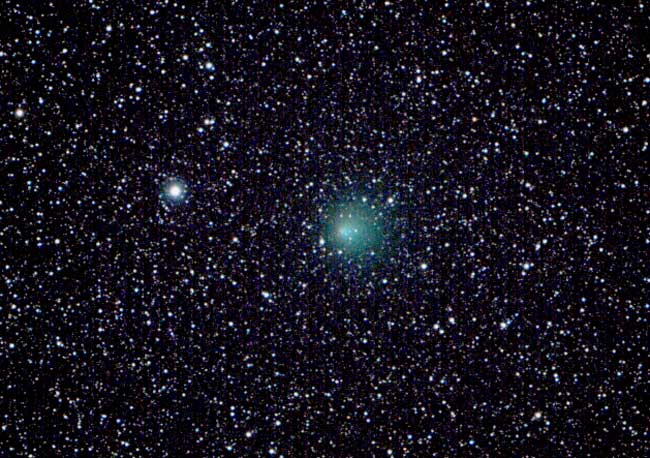
It's back. Every 3.3 years, Comet Encke swoops back into our inner Solar System. First officially discovered in 1786, Comet Encke is on its 59 th documented return, making it one of the best-studied comets on the sky. Mysteriously, Comet Encke should have been discovered millennia earlier, since it likely became bright enough to see unaided many times over the past few thousand years. Comet Encke's elliptical trajectory reaches from outside the orbit of Mars to inside the orbit of Mercury. It passed relatively close to the Earth on Nov. 17 and will reach its closest to the Sun on Dec 29. Recent observations place Comet Encke as bright as visual magnitude six during early December, making it just on the verge of unaided human vision. Pictured above, the diffuse smudge of periodic Comet Encke was imaged through a small telescope on November 29 from Arkansas, USA.