The Sun
The Sun is a yellow dwarf star (G2V), about 4.6 billion years old, and the dominant gravitational force in the Solar System. It has a diameter of roughly 1.4 million kilometers and contains around 99.8% of the Solar System’s mass. Nuclear fusion in its core converts hydrogen into helium, producing energy that warms the planets. Above the core lie the radiative and convective zones, followed by the visible photosphere (~5,500 °C), the chromosphere, and the much hotter corona (~2 million °C).
Source: science.nasa.gov
APODs including "The Sun"
Heaven on Earth
23/02/2004
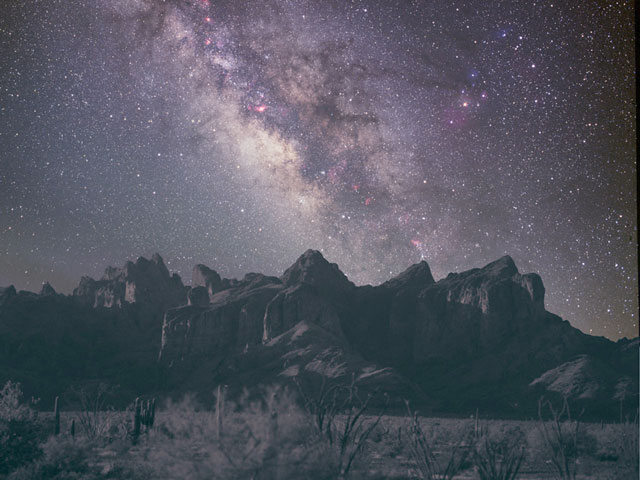
If sometimes it appears that the entire Milky Way Galaxy is raining down on your head, do not despair. It happens twice a day. As the Sun rises in the East, wonders of the night sky become less bright than the sunlight scattered by our own Earth's atmosphere, and so fade from view. They will only rotate back into view when the Earth again eclipses our bright Sun at dusk. This battle between heaven and Earth was captured dramatically in a digitally enhanced double-exposure over the Kofa Mountains in Arizona, USA in 2003 May. Dark dust, millions of stars, and bright glowing red gas highlight the plane of our Milky Way Galaxy, which lies on average thousands of light years behind Earth's mountains.