The Sun
The Sun is a yellow dwarf star (G2V), about 4.6 billion years old, and the dominant gravitational force in the Solar System. It has a diameter of roughly 1.4 million kilometers and contains around 99.8% of the Solar System’s mass. Nuclear fusion in its core converts hydrogen into helium, producing energy that warms the planets. Above the core lie the radiative and convective zones, followed by the visible photosphere (~5,500 °C), the chromosphere, and the much hotter corona (~2 million °C).
Source: science.nasa.gov
APODs including "The Sun"
Cassini Closes in on Saturn
01/03/2004
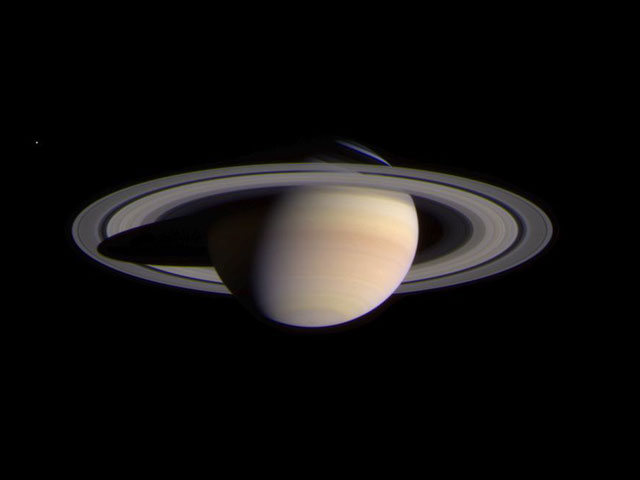
Are they gone? They were not originally predicted to even be there. The mystery revolves around strange shadow-like spokes that appeared on Saturn's large B-ring, the large middle ring in the complex system of particles that orbits Saturn. The spokes were discovered 23 years ago by the passing Voyager spacecraft and attributed to very fine dust of unknown origin. The missing spokes were noted in the above image, taken last month, from the robot Cassini spacecraft now approaching Saturn. Launched in 1997, the distance remaining between Cassini and Saturn is now less than half that between the Earth and the Sun. Cassini is expected to enter orbit around the ringed Jovian giant planet in July and drop a probe onto Titan, Saturn's largest moon.