The Sun
The Sun is a yellow dwarf star (G2V), about 4.6 billion years old, and the dominant gravitational force in the Solar System. It has a diameter of roughly 1.4 million kilometers and contains around 99.8% of the Solar System’s mass. Nuclear fusion in its core converts hydrogen into helium, producing energy that warms the planets. Above the core lie the radiative and convective zones, followed by the visible photosphere (~5,500 °C), the chromosphere, and the much hotter corona (~2 million °C).
Source: science.nasa.gov
APODs including "The Sun"
X-Ray Saturn
12/03/2004
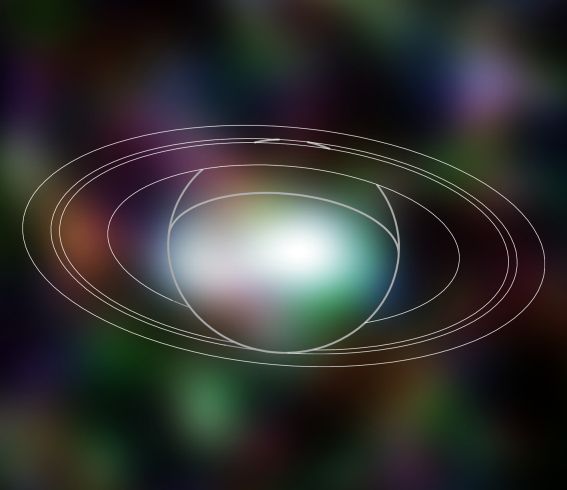
Above, the ringed planet Saturn shines in x-rays. Otherwise beyond the range of human vision, the eerie x-ray view was created by overlaying a computer generated outline of the gas giant's disk and ring system on a false-color picture of smoothed, reconstructed x-ray data from the orbiting Chandra Observatory. The data represent the first clear detection of Saturn's disk at x-ray energies and held some surprises for researchers. For starters, the x-rays seem concentrated near the planet's equator rather than the poles, in marked contrast to observations of Jupiter, the only other gas giant seen at such high energies. And while Saturn's high energy emission is found to be consistent with the reflection of x-rays from the Sun, the intensity of the reflected x-rays was also found to be unusually strong. Outside the planet's disk, only a faint suggestion of x-rays from Saturn's magnificent ring system is visible at the left.