The Sun
The Sun is a yellow dwarf star (G2V), about 4.6 billion years old, and the dominant gravitational force in the Solar System. It has a diameter of roughly 1.4 million kilometers and contains around 99.8% of the Solar System’s mass. Nuclear fusion in its core converts hydrogen into helium, producing energy that warms the planets. Above the core lie the radiative and convective zones, followed by the visible photosphere (~5,500 °C), the chromosphere, and the much hotter corona (~2 million °C).
Source: science.nasa.gov
APODs including "The Sun"
A Western Sky at Twilight
01/05/2004
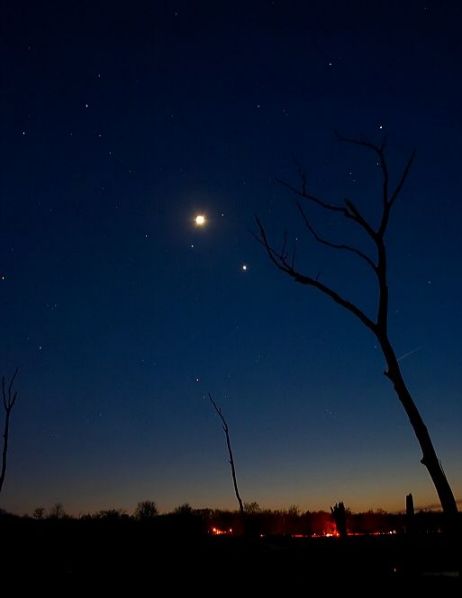
On April 23rd, the Moon along with planets Saturn, Mars, and Venus (and planet Earth of course ...) were all visible in the west at twilight, captured here from a site near Saylorvillle Lake north of Des Moines, Iowa, USA. Putting your cursor over the image will label our fellow solar system wanderers and also reveal the approximate trajectory of the ecliptic plane - defined by Earth's orbit around the Sun - angling above the western horizon. After sunset tonight, the western sky will present a similar arrangement of planets, although the Moon will have moved east out of the picture, passing bright Jupiter along the ecliptic and heading for May 4th's total lunar eclipse. May could also be a good month for comets.