The Sun
The Sun is a yellow dwarf star (G2V), about 4.6 billion years old, and the dominant gravitational force in the Solar System. It has a diameter of roughly 1.4 million kilometers and contains around 99.8% of the Solar System’s mass. Nuclear fusion in its core converts hydrogen into helium, producing energy that warms the planets. Above the core lie the radiative and convective zones, followed by the visible photosphere (~5,500 °C), the chromosphere, and the much hotter corona (~2 million °C).
Source: science.nasa.gov
APODs including "The Sun"
Comets Bradfield and LINEAR Rising
03/05/2004
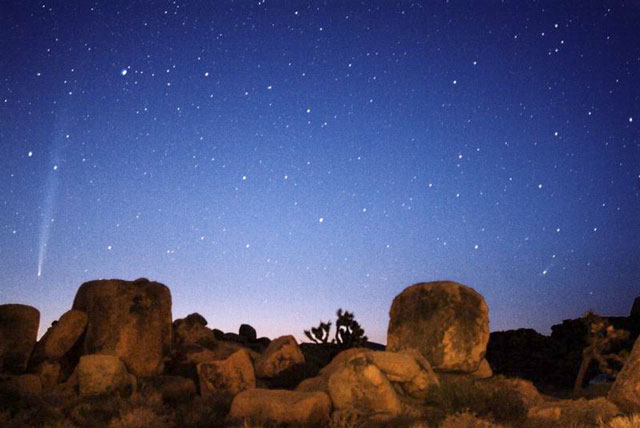
Comet Bradfield is easy to see on the left, but can you find Comet LINEAR on the right? Last week, just before sunrise from the northern hemisphere, two bright comets were visible in the same part of the sky at the same time. The above long-exposure image was taken on the morning of April 25 from Joshua Tree National Park in California, USA. Comet C/2004 F4 (Bradfield) is giving an unexpectedly good show as it recedes from the Sun and Earth and fades from view. Its tail is estimated by some to be about 10 degrees long. Having just rounded the Sun itself, Comet C/2002 T7 (LINEAR) is now moving toward the Earth. Although intrinsically fading, T7 will appear to brighten until about mid-May and so continue to be visible to the unaided eye before sunrise to southern hemisphere observers into June. Q4, the third coincidental naked eye comet, will become visible in mid-May to northern hemisphere observers.