The Sun
The Sun is a yellow dwarf star (G2V), about 4.6 billion years old, and the dominant gravitational force in the Solar System. It has a diameter of roughly 1.4 million kilometers and contains around 99.8% of the Solar System’s mass. Nuclear fusion in its core converts hydrogen into helium, producing energy that warms the planets. Above the core lie the radiative and convective zones, followed by the visible photosphere (~5,500 °C), the chromosphere, and the much hotter corona (~2 million °C).
Source: science.nasa.gov
APODs including "The Sun"
Sedna at Noon
04/06/2004
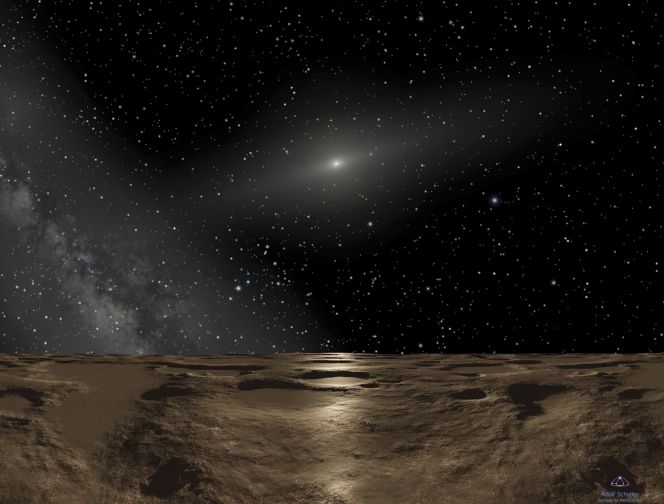
Standing on Sedna - the solar system's most distant known planetoid - your view of the Sun at high noon might look something like this. An artist's dramatic vision, the picture shows the Sun suspended above the nearby horizon as a bright star immersed in the dusty ecliptic plane. Within the dust-scattered sunlight are more familiar members of the solar system, including planet Earth. But at a distance of about 13 billion kilometers (8 billion miles) Earth would only be visible in binoculars or a small telescope. In Sedna's dark, daytime skies, the noonday Sun is also joined by the faint stars and obscuring dust clouds of the Milky Way, suspended on the left above stark, ruddy terrain. For Sedna-based sky gazers, all planets have interior orbits and would remain close to the Sun in Sedna's skies. Of course, for earthbound astronomers, interior planets Venus and Mercury also remain near the Sun, with Venus scheduled for a rare crossing of the solar disc on June 8.