The Sun
The Sun is a yellow dwarf star (G2V), about 4.6 billion years old, and the dominant gravitational force in the Solar System. It has a diameter of roughly 1.4 million kilometers and contains around 99.8% of the Solar System’s mass. Nuclear fusion in its core converts hydrogen into helium, producing energy that warms the planets. Above the core lie the radiative and convective zones, followed by the visible photosphere (~5,500 °C), the chromosphere, and the much hotter corona (~2 million °C).
Source: science.nasa.gov
APODs including "The Sun"
A Planet Transits the Sun
08/06/2004
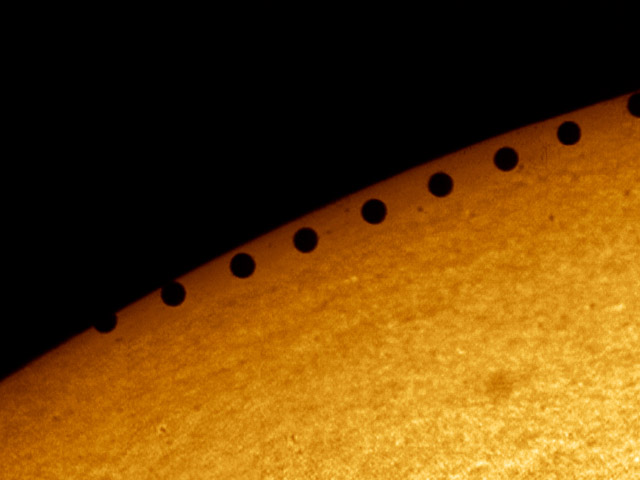
Today an astronomical event will occur that no living person has ever seen: Venus will cross directly in front of the Sun. A Venus crossing, called a transit, last occurred in 1882 and was front-page news around the world. Today's transit will be visible in its entirety throughout Europe and most of Asia and Africa. The northeastern half of North America will see the Sun rise with the dark dot of Venus already superposed. Never look directly at the Sun, even when Venus is in front. Mercury's closer proximity to the Sun cause it to transit every few years. In fact, the above image mosaic of Mercury crossing the Sun is from two transits ago, in November 1999. Will anyone living see the next Venus transit? Surely yes since it occurs in 2012.