The Sun
The Sun is a yellow dwarf star (G2V), about 4.6 billion years old, and the dominant gravitational force in the Solar System. It has a diameter of roughly 1.4 million kilometers and contains around 99.8% of the Solar System’s mass. Nuclear fusion in its core converts hydrogen into helium, producing energy that warms the planets. Above the core lie the radiative and convective zones, followed by the visible photosphere (~5,500 °C), the chromosphere, and the much hotter corona (~2 million °C).
Source: science.nasa.gov
APODs including "The Sun"
Venus Transit at Sunrise
09/06/2004
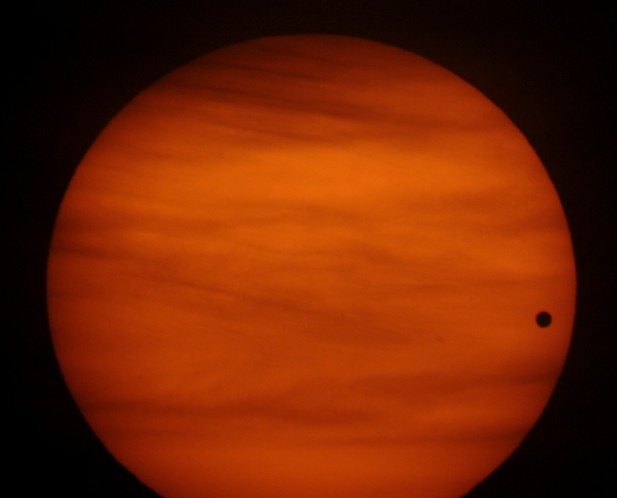
Did you see the transit? While some watched by webcast, sky gazers in Europe, the Middle East, Africa, and Asia were able to witness the complete 6 hour journey of Venus' silhouetted disk across the face of the Sun. As seen from North America, the much heralded Venus Transit of 2004 was nearing its final stages at sunrise yesterday in this telescopic image. The view looks across the Atlantic from Tybee Island near Savannah, Georgia, USA. In fact, many in eastern North America experienced a dramatic view of a perfect, dark, round Venus against a reddened Sun filtered by banks of low clouds. Ironically, the Sun takes on the appearance of a cloud covered planet itself as Venus marches toward the right through this dreamlike scene.