The Sun
The Sun is a yellow dwarf star (G2V), about 4.6 billion years old, and the dominant gravitational force in the Solar System. It has a diameter of roughly 1.4 million kilometers and contains around 99.8% of the Solar System’s mass. Nuclear fusion in its core converts hydrogen into helium, producing energy that warms the planets. Above the core lie the radiative and convective zones, followed by the visible photosphere (~5,500 °C), the chromosphere, and the much hotter corona (~2 million °C).
Source: science.nasa.gov
APODs including "The Sun"
Venus at the Edge
10/06/2004
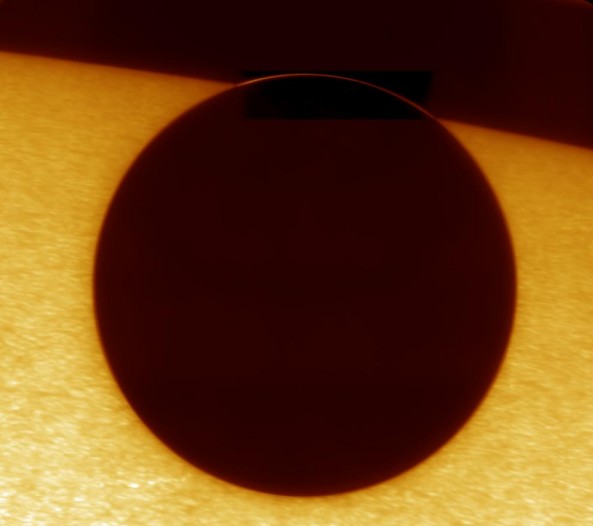
With Venus in transit at the Sun's edge on June 8th, astronomers captured this tantalizing close-up view of the bright solar surface and partially silhouetted disk. Enhanced in the sharp picture, a delicate arc of sunlight refracted through the Venusian atmosphere is also visible outlining the planet's edge against the blackness of space. The arc is part of a luminous ring or atmospheric aureole, first noted and offered as evidence that Venus did posses an atmosphere following observations of the planet's 1761 transit. The image was recorded using the 1-meter Swedish Solar Telescope located on La Palma in the Canary Islands. For the Institute for Solar Physics, Dan Kiselman, Goran Scharmer, Kai Langhans, and Peter Dettori were at the telescope, while Mats Lofdahl produced the final image. Excellent movies of the transit - including one of the emergence of Venus' atmospheric aureole - are available from the Dutch Open Telescope, also observing from La Palma.