The Sun
The Sun is a yellow dwarf star (G2V), about 4.6 billion years old, and the dominant gravitational force in the Solar System. It has a diameter of roughly 1.4 million kilometers and contains around 99.8% of the Solar System’s mass. Nuclear fusion in its core converts hydrogen into helium, producing energy that warms the planets. Above the core lie the radiative and convective zones, followed by the visible photosphere (~5,500 °C), the chromosphere, and the much hotter corona (~2 million °C).
Source: science.nasa.gov
APODs including "The Sun"
Analemma over Ancient Nemea
21/06/2004
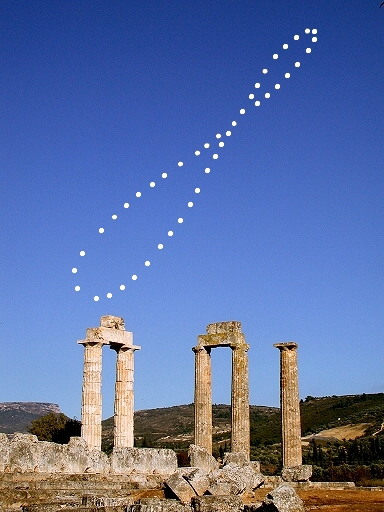
An analemma is that figure-8 curve that you get when you mark the position of the Sun at the same time each day throughout planet Earth's year. Above, 44 separate exposures (plus one foreground exposure) were recorded on a single piece of film to illustrate the regular solar motion -- a Herculean task performed during the calendar year 2003. Appropriately, in the foreground are the ruins at Ancient Nemea where the hero of Greek Mythology pursued the first of his twelve labours. Solstices, like the one that occurred at 0057 UT on June 21, correspond to the top and bottom of the figure-8 or the northern and southernmost excursions of the Sun in the sky. The tilt of planet Earth's axis and the variation in speed as it moves around its orbit combine to produce the graceful analemma curve.