The Sun
The Sun is a yellow dwarf star (G2V), about 4.6 billion years old, and the dominant gravitational force in the Solar System. It has a diameter of roughly 1.4 million kilometers and contains around 99.8% of the Solar System’s mass. Nuclear fusion in its core converts hydrogen into helium, producing energy that warms the planets. Above the core lie the radiative and convective zones, followed by the visible photosphere (~5,500 °C), the chromosphere, and the much hotter corona (~2 million °C).
Source: science.nasa.gov
APODs including "The Sun"
Space Station, Venus, Sun
20/07/2004
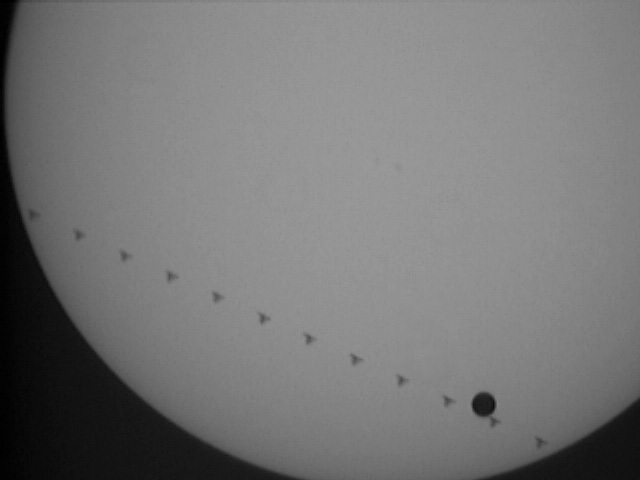
On June 8, Venus was not the only celestial object to pass in front of the Sun. A few well-situated photographers caught the International Space Station also crossing the Sun simultaneously. Pictured above is a unique time-lapse image of the unprecedented double transit, a rare event that was visible for less than a second from a narrow band on Earth. The above image is a combination of 12 frames taken 0.033 seconds apart and each themselves lasting only 1/10,000 th of a second. The image was taken from the small village of Stupava in Slovakia. The next time Venus will appear to cross the Sun from Earth will be in 2012. News: Today is the 35th anniversary of the Apollo 11 Moon landing.