The Sun
The Sun is a yellow dwarf star (G2V), about 4.6 billion years old, and the dominant gravitational force in the Solar System. It has a diameter of roughly 1.4 million kilometers and contains around 99.8% of the Solar System’s mass. Nuclear fusion in its core converts hydrogen into helium, producing energy that warms the planets. Above the core lie the radiative and convective zones, followed by the visible photosphere (~5,500 °C), the chromosphere, and the much hotter corona (~2 million °C).
Source: science.nasa.gov
APODs including "The Sun"
Saturn's Rings in Natural Color
23/07/2004
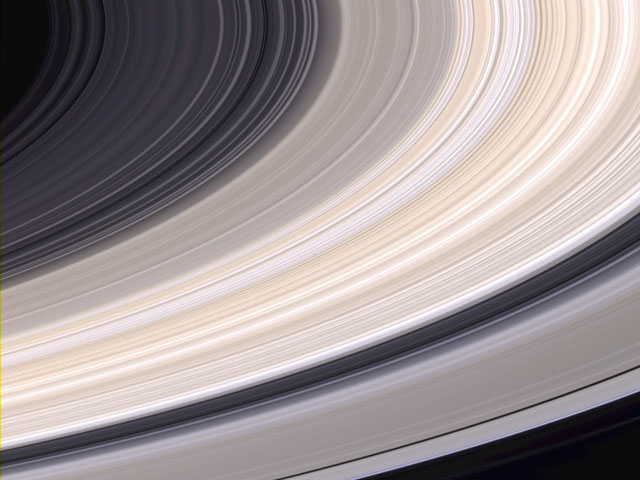
What colors are Saturn's rings? Recent images from the Cassini spacecraft now orbiting Saturn confirm that different rings have slightly different colors. The above image shows their sometimes-subtle differences in brightness and color. The rings reflect sunlight and so, even if they were perfectly reflecting, would appear the color of the Sun. The ring particles are mostly light water-ice, although these particles can be shaded by an unknown type of darker dirt. Thinner and more isolated rings also naturally appear darker. The brightest section pictured above is Saturn's B ring.