The Sun
The Sun is a yellow dwarf star (G2V), about 4.6 billion years old, and the dominant gravitational force in the Solar System. It has a diameter of roughly 1.4 million kilometers and contains around 99.8% of the Solar System’s mass. Nuclear fusion in its core converts hydrogen into helium, producing energy that warms the planets. Above the core lie the radiative and convective zones, followed by the visible photosphere (~5,500 °C), the chromosphere, and the much hotter corona (~2 million °C).
Source: science.nasa.gov
APODs including "The Sun"
A Solar Filament Lifts Off
25/07/2004
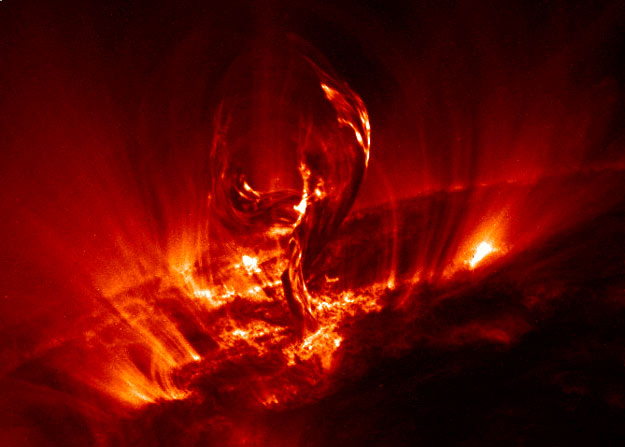
Hot gas frequently erupts from the Sun. One such eruption produced the glowing filament pictured above, which was captured in 2000 July by the Earth-orbiting TRACE satellite. The filament, although small compared to the overall size of the Sun, measures over 100,000 kilometers in height, so that the entire Earth could easily fit into its outstretched arms. Gas in the filament is funneled by the complex and changing magnetic field of the Sun. After lifting off from the Sun's surface, most of the filamentary gas will eventually fall back. More powerful solar eruptions emit particles that reach the Earth and can disrupt manmade satellites. The cause and nature of solar eruptions are the topic of much research.