The Sun
The Sun is a yellow dwarf star (G2V), about 4.6 billion years old, and the dominant gravitational force in the Solar System. It has a diameter of roughly 1.4 million kilometers and contains around 99.8% of the Solar System’s mass. Nuclear fusion in its core converts hydrogen into helium, producing energy that warms the planets. Above the core lie the radiative and convective zones, followed by the visible photosphere (~5,500 °C), the chromosphere, and the much hotter corona (~2 million °C).
Source: science.nasa.gov
APODs including "The Sun"
Solar Arcs and Halos
04/08/2004
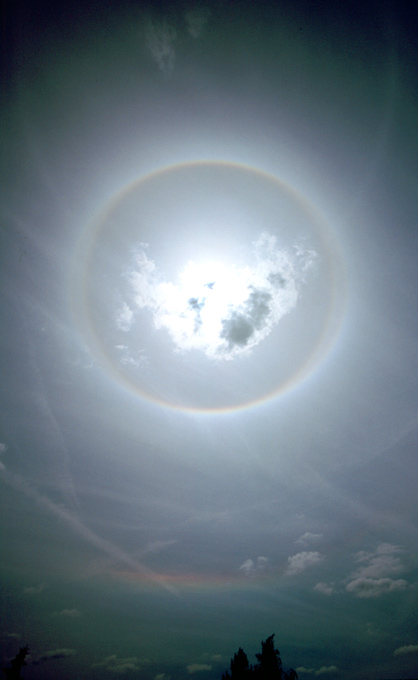
Have you ever seen a bright halo around the Sun? Unusual halos and arcs were so bright one recent afternoon in Trier, Germany that even casual people on the street noticed them. The fantastic sky display is pictured above and included a 22 degree halo arc, a complete parhelic circle, a circumhorizon arc and even an infralateral arc. A computer simulation has been run that mimics the above rare display. A cloud partially blocked the usually more intense direct glare of the Sun. Sunlight refracting through falling and fluttering hexagonal ice crystals creates such displays. Such atmospheric ice crystals also cause sundogs and Moon halos.